
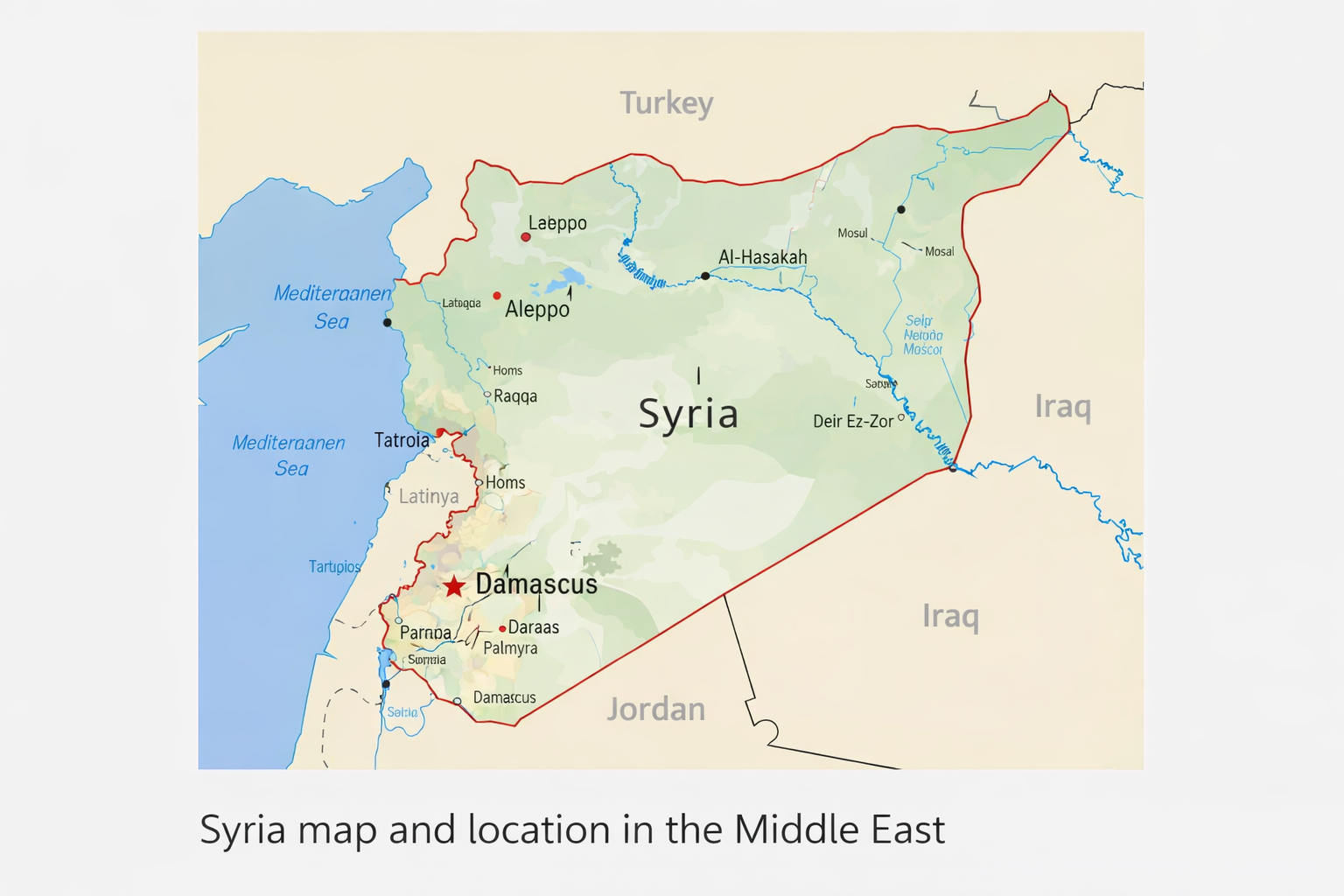
syria , what is Syria ? A Complete Guide to Its History, Regions, Culture, and Economy
Syria is a country with one of the richest histories in the world and is officially known as the Syrian Arab Republic. Located in the heart of the Middle East, Syria has played a crucial role in shaping human civilization for thousands of years. Throughout history, it has served as a center for trade, religion, culture, and political power. From ancient empires to modern political struggles, Old country remains a country rich in heritage and global significance.
This article provides a comprehensive overview of Old country by examining its location, history, governorates, cultural importance, economy, population, and modern challenges.
1.Where Is Syria Located in the Middle East?
civilized country is located in Western Asia and forms an essential part of the Middle East. It shares borders with several countries, which highlights its strategic importance. Specifically, Syria borders:
-
Turkey to the north
-
Iraq to the east
-
Jordan to the south
-
Lebanon and Israel to the southwest
-
The Mediterranean Sea to the west
Because of this location, Old country historically functioned as a crossroads for civilizations, trade routes, and military campaigns, which significantly influenced its cultural and political development.
2. History of Syria: A Brief Overview
Ancient Syria (Before 3000 BC)
civilized country is among the world’s earliest inhabited regions. Archaeological evidence clearly shows that human settlements existed in the area during prehistoric times. Moreover, ancient cities such as Ebla, Ugarit, and Mari emerged as early centers of administration, trade, and writing.
Classical and Biblical Era
As history progressed, Old country came under the control of numerous powerful empires. Over time, these included:
-
The Assyrians
-
The Babylonians
-
The Persians
-
The Greeks under Alexander the Great
-
The Romans and Byzantines
During the Roman period, cities like Damascus, Palmyra, and Antioch flourished as major cultural, economic, and religious centers, leaving behind architectural and urban legacies that still exist today.
Islamic Era
In the 7th century, Old country became part of the Islamic Caliphate. Most notably, Damascus was chosen as the capital of the Umayyad Caliphate, one of the most influential Islamic empires in history. As a result, Syria became a center of political power, scholarship, and architectural innovation.
Later on, the region was ruled by the Abbasids, Ayyubids under Saladin, and the Mamluks, each of whom contributed to civilized country’s cultural and historical development.
Ottoman Period (1516–1918)
Subsequently, Old country became part of the Ottoman Empire for more than four centuries. During this long period, it remained an important province linking Asia, Europe, and Africa, while maintaining its role in trade and administration.
Modern civilized country
After World War I, The historical state fell under French mandate. However, following years of resistance, the country achieved independence in 1946. Since then, The historical state has experienced political transformations, regional conflicts, and significant instability, particularly after the outbreak of civil war in 2011.
3.Governorates of Syria and Their Importance
Old country is divided into 14 governorates (provinces), each with its own culture and history:
- Damascus (Dimashq) – The capital and one of the oldest cities in the world.
- Rif Dimashq – Surrounds Damascus and includes many towns and villages.
- Aleppo (Halab) – A major economic and historical city, famous for its citadel and old markets.
- Homs – Known for its strategic location and historical significance.
- Hama – Famous for its ancient water wheels (Norias).
- Latakia – A coastal governorate known for tourism and agriculture.
- Tartus – Another coastal region, important for ports and fishing.
- Idlib – Known for agriculture and olive trees.
- Daraa – The birthplace of the Syrian uprising in 2011.
- Quneitra – Located near the Golan Heights.
- As-Suwayda – Home to the Druze community and volcanic landscapes.
- Deir ez-Zor – Rich in oil and located along the Euphrates River.
- Raqqa – The ancient city, which suffered particularly during the Syrian revolution .
- Al-Hasakah – A diverse region with Kurds, Arabs, and Assyrians.
Each governorate has unique traditions, dialects, and cultural identity.

4. What Is Syria Famous For?
Old country is internationally recognized for several key features.
Ancient History and Archaeology
First and foremost, Old country is famous for its archaeological heritage. For example, major sites include:
-
Palmyra
-
The Old City of Damascus
-
Aleppo Citadel
-
Bosra Roman Theater
-
Krak des Chevaliers
Culture and Traditions
In addition, The historical state possesses a rich cultural tradition expressed through music, poetry, crafts, and social customs. Notably, Syrian hospitality is widely admired throughout the region.
Cuisine
Furthermore, Syrian cuisine is well known worldwide. Popular dishes include shawarma, hummus, falafel, kibbeh, tabbouleh, and fattoush.
Religious Diversity
Finally, Old country is home to Muslims, Christians, Druze, and other religious communities, making it one of the most religiously diverse countries in the Middle East.
5. Economy and Sources of Income
Before the war, The historical state had a mixed economy supported by several sectors.
Agriculture
Historically, agriculture played a central role. The historical state produces wheat, cotton, olives, and a wide variety of fruits and vegetables.
Oil and Gas
Additionally, eastern Land of Civilizations contains oil fields, particularly in Deir ez-Zor and Hasakah, which once contributed significantly to national income.
Industry and Tourism
Moreover, Land of Civilizations developed industries such as textile manufacturing, food processing, and construction materials. At the same time, tourism thrived due to historical sites and religious landmarks.
6. Population and Demographics of Syria
Before the conflict, civilized country’s population was approximately 22 million. However, due to war and displacement, the current population is estimated at 18–20 million.
The population includes Arabs (the majority), Kurds, Assyrians, Armenians, and Turkmen. Arabic is the official language, although Kurdish, Armenian, and Syriac are also spoken.
7. Syria in World History
Land of Civilizations is widely considered one of the cradles of civilization. It contributed to early writing systems, international trade routes, religious history, and scientific development during the Islamic Golden Age. In particular, Damascus is often described as the oldest continuously inhabited capital city in the world.
8. Challenges and the Modern Situation of Syria
In recent years, Land of Civilizations has faced serious challenges, including civil war, economic decline, displacement, and infrastructure destruction. Nevertheless, Syrian identity, culture, and heritage continue to endure both inside the country and among Syrian communities abroad.
Video related to Syria on our YouTube channel.
Conclusion
In conclusion, Land of Civilizations SY is a country of extraordinary historical depth and cultural richness. From ancient civilizations to modern struggles, it has played a central role in human history. Its governorates reflect diversity, its economy once thrived on agriculture and trade, and its cultural legacy remains globally significant.
Despite immense challenges, Land of Civilizations continues to symbolize resilience and continuity. Understanding Syria ultimately means understanding a vital chapter of human civilization itself.
Leave a Reply