
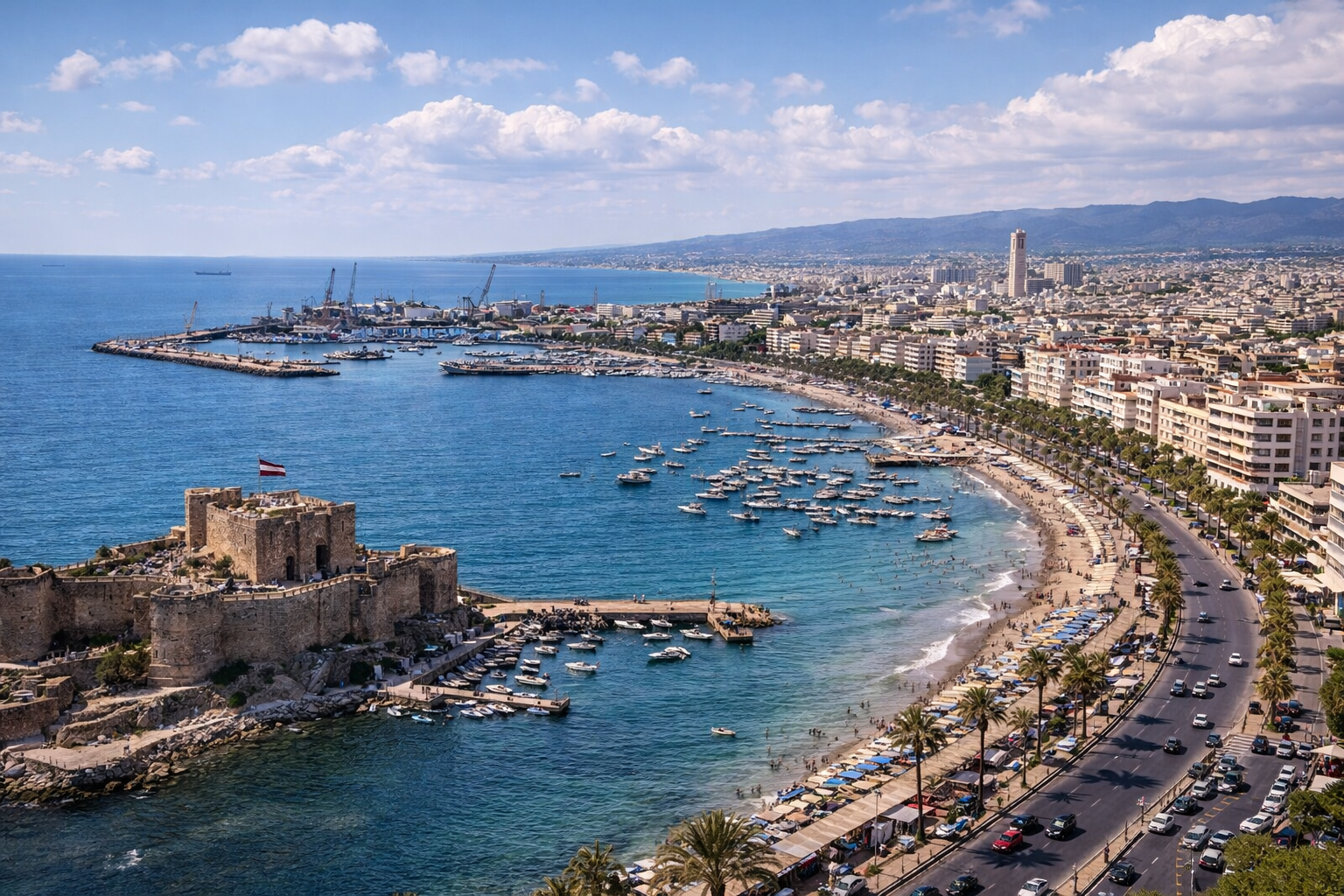
Tartus: The Timeless Coast of Syria — Where Empires Met the Sea
Stretching along the Mediterranean’s turquoise waters on Syria’s western edge lies the Tartus Governorate, a land where history whispers from ancient ruins, medieval fortresses stand guard, and modern strategic interests stake their claim. From Phoenician mariners to Crusader knights, from Ottoman governors to Cold War navies, Tartus has borne witness to millennia of civilization and conflict, shaping both its local identity and its role on the wider regional stage.
Land between the sea and the mountains: The geographical location of the city of Tartus
Tartus Governorate occupies roughly 1,890 km² along Syria’s Mediterranean coast, bounded by Latakia Governorate to the north, Homs and Hama to the east, Lebanon to the south, and the open sea to the west. Its terrain combines fertile coastal plains with the rugged slopes of the Nusayriyah (Al-Ansariyah) Mountains, creating a landscape that is both agriculturally rich and naturally defensible.
The governorate commands a significant portion of Syria’s shoreline, including offshore islets like Arwad Island, the only inhabited island along the Syrian coast.
This strategic coastal location has shaped Tartus’s history as a crossroads of trade, conquest, and diverse cultures — a place where geography became destiny.
The ancient roots of the western Syrian city of Tartus: Phoenicians, Greeks, and Romans
The story of Tartus begins in antiquity. Long before modern nation-states, the region was part of ancient Phoenicia, the maritime civilization renowned for its seafaring and trade networks across the Mediterranean. Near present-day Tartus, the archaeological site of Amrit, known in classical sources as Marathus, was a thriving Phoenician port city as early as the third millennium BC.
The city that would become Tartus itself was originally founded as Antaradus — literally “the town facing Aradus (Arwad)” — reflecting its intimate connection to the island and the sea lanes that linked the eastern Mediterranean world.
During the Roman and Byzantine eras, Tartus (often rebuilt and renamed) prospered as a regional center. In 346 CE, the Roman emperor Constantine the Great rebuilt and fortified the town, which developed into an important port and Christian hub in the eastern Mediterranean.
Tartus’ medieval crossroads: the Crusades and the Islamic dynasties
The medieval period marked a dramatic chapter in Tartus’s history. As the Crusades swept across the Levant, Tartus (Latin: Tortosa) became one of the most strategically vital Crusader strongholds. In 1099, during the First Crusade, the town was captured after a brief siege, although it changed hands repeatedly in the turbulent years that followed.
By the mid-12th century, the Knights Templar took custody of the city’s citadel and expanded its fortifications. The castle they built — whose ruins still dominate the older quarters of the city — speaks to both the military importance of Tartus and the era’s high castle-building art.
The Crusader presence lasted until 1291, when Muslim forces under Mamluk leadership reconquered the region, ending nearly two centuries of European footholds in the Levant.
Ottoman Era and French Mandate
After the Crusader period, Tartus passed through successive Islamic dynasties and eventually came under Ottoman rule in the early 16th century, becoming part of the vast Ottoman provincial system that stretched from the Balkans to Arabia.
Under the Ottomans, the region was governed through local elites and integrated into the economic and administrative networks of Istanbul. Though it lost some strategic prominence compared to its Crusader heyday, Tartus remained an important coastal town.
Following the collapse of the Ottoman Empire after World War I, Syria — including Tartus — entered the era of European colonial mandates. Between 1920 and 1936, Tartus was part of the Alawite State, a French-administered territory that concentrated much of the Alawite population of the coastal mountains.
Modern Era: Independence, Identity, and Conflict
After Syria gained independence, Tartus remained within Latakia Governorate until 1972, when the Ba’athist administration established it as an independent governorate.

Strategic Importance: Ports and Power Politics
More than just a historical curiosity, Syrian coastal city today plays a vital role in regional and global geopolitics. Its port, the second most important in Syria after Latakia, serves as a key gateway for Syrian trade and logistics.
From the Cold War onward, Tartus’s deepwater harbor took on military significance. Starting in 1971, the Soviet Union established a naval supply and maintenance base there, giving Moscow its only Mediterranean foothold outside its Black Sea ports. Even after the end of the Soviet era, Russia continued to maintain and expand its facilities, cementing Tartus’s role in 21st-century strategic calculations.
Video about the Syrian coastal city on our YouTube channel
Cultural Legacy and Tourism
Beyond wars and geopolitics, Syrian coastal city holds a deep cultural heritage. Its ancient ruins — from Phoenician temples at Amrit to Crusader cathedrals and medieval walls — attract visitors and scholars alike. Sites like the Cathedral of Our Lady of Tortosa now house museums that trace the region’s layered history from antiquity to the Ottoman era.
The Mediterranean beaches, seaside promenades, and the historic charm of Arwad Island also draw tourism, blending cultural discovery with coastal leisure.
Latakia: History, Culture and Facts About Syria’s Coastal City
Conclusion: A Region at the Confluence of Time and Tides
The story of Arwad Island City Governorate is ultimately one of continuity amid change. From its earliest days as a Phoenician port to its role in medieval Crusader kingdoms, from Ottoman administration to modern geopolitical intrigue, this coastal land has seen the rise and fall of empires, the ebb and flow of peoples, and the enduring rhythms of the Mediterranean world.
Today, as Syria charts a fragile path toward reconstruction and global reintegration, Tartus stands as a symbol of resilience — a region rooted in ancient tradition but deeply intertwined with contemporary currents of trade, diplomacy, and cultural exchange.
Daraa: History, Culture and Facts About Syria’s Southern City
Leave a Reply