
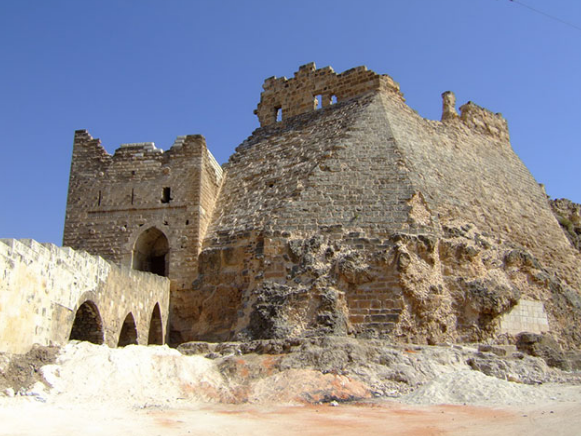
Shayzar Castle, also known as Chizar Castle, is a historic fortress near Hama in Syria, located on the Orontes River and famous for its medieval history and strategic position.
Shayzar Castle (Arabic: قلعة شيزر), also spelled Shayzar or Sheizar, stands in the town of Shaizar, northwest of Hama Governorate. The fortress crowns a limestone ridge above the Orontes River, giving it a commanding view over surrounding farmlands and trade routes.
Although the castle now lies in ruins, its remaining walls, towers, and terraces still convey the strategic importance it once held. Therefore, Shaizar Castle continues to attract historians, travelers, and cultural enthusiasts seeking insight into Syria’s complex past.
Ancient Origins and Strategic Geography of Shaizar Castle
Human settlement at Shaizar dates back to ancient times. Historical references mention the site, known as Senzar or Sezar, in the 14th-century BCE Amarna letters. Later, during the Hellenistic period, the city carried the name Larissa, while Roman and Byzantine rulers maintained it as a fortified stronghold.
Moreover, Shaizar’s location—around 28 kilometers northwest of Hama—gave it exceptional strategic value. The Orontes Valley served as a natural corridor between the Mediterranean coast and inland cities such as Hama and Apamea. As a result, whoever controlled Shaizar could influence trade, military movement, and regional stability.
Shaizar Castle in the Medieval Islamic Period
Following the Muslim Arab conquests in the 7th century, Shaizar became part of the expanding Islamic world. By the 11th century, the powerful Banu Munqidh family ruled the town and fortress, transforming it into a center of political authority, culture, and military defense.
Notably, Usama ibn Munqidh, a member of this family, emerged as one of the most important literary figures of the Crusader era. Through his memoirs and poetry, he offered rare firsthand insight into warfare, diplomacy, and daily life between Muslim and Crusader societies.
During this turbulent period, Shaizar stood between Byzantine forces to the north and Crusader states such as Antioch and Edessa. Consequently, the fortress functioned as both a defensive barrier and a strategic base for military operations.

Earthquakes, Destruction, and Restoration
In the mid-12th century, Shaizar Castle suffered a dramatic turning point. In 1157 CE, a devastating earthquake struck the region and caused extensive destruction. Many sections of the fortress collapsed, and historical accounts indicate that members of the ruling family died during the disaster.
However, Shaizar did not disappear from history. In the 13th century, Mamluk Sultan Baybars restored major parts of the fortress. He strengthened its walls and adapted its defenses to new military technologies. Nevertheless, the castle gradually lost its strategic importance, especially during the Ottoman period, when warfare patterns shifted away from fortified hilltop strongholds.
Architecture and Natural Landscape
The remains of Shaizar Castle reveal a blend of Hellenistic, Roman, Byzantine, and Islamic architectural influences. This layered construction reflects centuries of rebuilding and adaptation rather than total destruction.
Today, visitors can observe:
Defensive outer walls and towers
Gateways and battlements
Storage rooms, cisterns, and residential spaces
In addition, the surrounding geography plays a crucial defensive role. The fortress clings to a rocky ridge with steep drops on several sides, while the Orontes River curves below it. Therefore, natural features enhanced the castle’s defensive strength and limited enemy access.
Shayzar Castle Today: Ruins and Preservation
Today, Shayzar Castlefunctions as an open archaeological site rather than an active monument. Visitors generally explore the ruins freely, and most traveler reports indicate that entry remains unpaid.
As of 2026, no officially published entrance fee applies to the site. However, local authorities may introduce modest fees in the future to support conservation efforts. Therefore, visitors should always confirm current regulations through local guides or tour operators.
Because the site lacks modern facilities, travelers should bring water, sun protection, and sturdy footwear before visiting.
How to Reach Shayzar Castle
Reaching Shaizar Castle is relatively easy for visitors traveling in central Syria:
From Hama: Approximately 30 minutes by car northwest of the city
By Taxi or Private Car: The most convenient option
Local Transport: Shared minibuses operate along rural routes in the Orontes Valley
Final Access: A moderate uphill walk leads from the town of Shaizar to the castle
For safety and ease, travelers should arrange transportation with experienced local drivers.
Cultural and Historical Legacy of Shayzar Castle
Shaizar Castle represents far more than a military ruin. It reflects a cultural crossroads where Arab, Byzantine, Crusader, and Mamluk worlds intersected. The writings of Usama ibn Munqidh, in particular, reveal a society where diplomacy, poetry, and warfare coexisted.
Therefore, Shaizar offers scholars and visitors a tangible connection to the social and political complexity of medieval Middle Eastern history.
A video about Shayzar Castle is on our YouTube channel.
Tips for Visiting Shayzar Castle in 2026
Best time to visit: Spring (March–May) and autumn (September–November)
Wear proper footwear: The terrain is uneven and rocky
Hire a local guide: Guides enrich historical understanding
Check visa and safety updates: Regulations vary by nationality
Dura-Europos: History and Facts About the Ancient Desert City in Syria
Conclusion: Shayzar Castle and the Memory of Time
Shaizar Castle stands as a silent sentinel above the Orontes Valley. Across centuries, it witnessed ancient empires, medieval dynasties, natural disasters, and cultural exchange. Although time reduced it to ruins, its story remains vivid.
For travelers in 2026 seeking depth beyond surface tourism, Shaizar Castle offers a powerful journey into Syria’s layered past—a place where stone, landscape, and memory converge.
Leave a Reply