
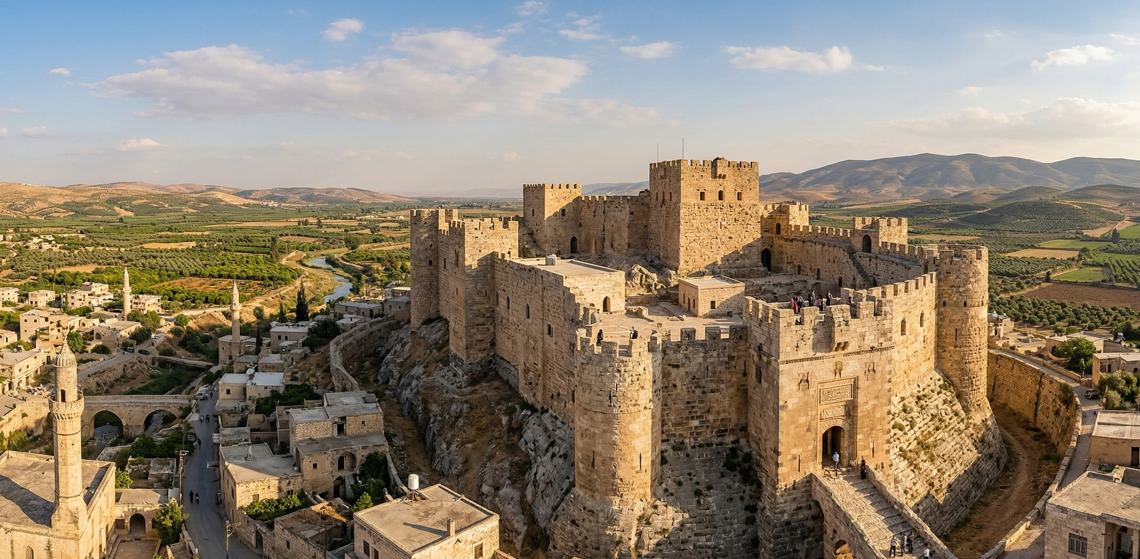
Sarmin Castle (Sarmin): A Medieval Watch Fortress in the Idlib Countryside
Location and Strategic Importance of Sarmin Castle
Sarmin Castle stands near the historic town of Sarmin in the eastern countryside of Idlib, in northwestern Syria. The site occupies a strategic position within a landscape shaped by fertile plains, agricultural villages, and historic trade corridors that once connected Aleppo with the Mediterranean region.
Because of its location, Sarmin Castle played a key role in monitoring regional movement. The surrounding plains allowed travelers, merchants, and armies to move quickly across the countryside. As a result, controlling elevated positions like Sarmin became essential for maintaining regional security.
The castle overlooked secondary trade routes that connected inland towns with larger economic centers. These routes transported grain, olives, textiles, and livestock. Therefore, the fortress helped protect both economic activity and local communities.
In addition, the landscape around Sarmin offered a natural defensive advantage. Gentle hills and open fields created wide visibility. Guards stationed at the castle could detect approaching travelers from long distances. Consequently, Sarmin Castle functioned as an early warning station within a wider defensive network.
History of Sarmin Castle
Sarmin Castle likely dates back to the medieval Islamic period, when northern Syria experienced intense political competition. During the 12th and 13th centuries, the region became a frontier zone between Crusader territories and Islamic states.
Because of this unstable environment, rulers invested heavily in fortifications. Large castles protected major cities, while smaller strongholds secured rural routes and agricultural areas. Sarmin Castle most likely served as one of these supporting fortresses.
The castle may have played a role during the struggles between the Zengids, Ayyubids, and later the Mamluks. These dynasties worked to strengthen regional defenses and maintain control over strategic territories. Smaller forts like Sarmin supported communication and surveillance across the countryside.
During the Mamluk period, military organization became more centralized. Major fortresses gained priority, and smaller sites gradually lost importance. As trade routes evolved and political conditions stabilized, Sarmin Castle’s defensive value declined.
By the Ottoman era, the fortress no longer served a military purpose. Without continued maintenance, the structure slowly deteriorated. Over centuries, natural erosion and human activity reduced the castle to scattered remains.
Architecture of Sarmin Castle
The architecture of Sarmin Castle reflects practicality and adaptation to the local environment. Builders used locally sourced stone, which blended naturally with the surrounding landscape and provided durability.
Unlike large castles, Sarmin Castle likely followed a compact layout. Its design focused on observation and short-term defense rather than long sieges. Thick stone walls provided protection against small-scale attacks.
The castle probably included a watchtower or elevated observation points. These features allowed guards to monitor the plains and nearby routes. Visibility was the most valuable defensive tool in this open landscape.
Inside the fortress, the layout was simple and functional. The structure likely contained small rooms for soldiers, storage areas for supplies, and open courtyards. The design prioritized efficiency over decoration.
Water storage played a vital role in sustaining the garrison. Builders likely constructed cisterns to collect rainwater. This ensured that the fortress could remain operational even during periods of isolation.
Today, only limited remains survive. However, traces of stone foundations and scattered walls still reveal the original footprint of the castle.
Sarmin Castle and Regional Defense Networks
Sarmin Castle did not operate in isolation. Instead, it formed part of a wider defensive system across northwestern Syria. This network included castles, watchtowers, and fortified towns that communicated through visibility and signal systems.
When guards detected movement, they could alert nearby settlements. This early warning system helped communities prepare for potential threats. As a result, smaller fortresses played an essential role in regional stability.
The castle also supported agricultural security. Protecting farmland ensured food supplies for nearby cities. Therefore, Sarmin Castle contributed to both military defense and economic sustainability.
Understanding these networks helps historians reconstruct how medieval societies managed large territories. Smaller fortifications like Sarmin were crucial pieces of a much larger strategy.
Why Sarmin Castle Matters Today
Sarmin Castle represents an important part of Syria’s cultural and historical landscape. Although it is not widely known, the site illustrates how rural areas contributed to major historical events.
The fortress provides insight into everyday military life during the medieval period. It shows how soldiers lived, worked, and protected local communities far from major cities.
In addition, Sarmin Castle highlights the importance of preserving lesser-known heritage sites. Famous landmarks often attract attention, but smaller sites complete the historical narrative.
Promoting awareness of places like Sarmin Castle supports cultural tourism and encourages historical research. These sites offer authentic experiences for visitors interested in exploring hidden heritage.
How to Visit Sarmin Castle
Visitors can reach Sarmin Castle by traveling to Idlib and then heading east toward Sarmin. Regional roads connect the town with surrounding villages and countryside.
The final approach to the castle may involve walking across uneven terrain. Comfortable footwear is recommended for safety and convenience.
Carrying water is essential, especially during warmer months. The open landscape offers limited shade and can become hot during summer.
Spring and autumn provide the best visiting conditions. Moderate temperatures make exploration more comfortable and enjoyable.
Before traveling, visitors should always check local conditions. Access may vary depending on the situation. Hiring a local guide can enrich the experience and provide valuable historical context.
Conclusion
Sarmin Castle stands as a quiet witness to the complex history of northwestern Syria. Although it was not a massive fortress, it played a vital role in protecting trade routes, farmland, and local communities.
Its strategic position allowed guards to monitor movement across the plains. Over time, changing political and military conditions reduced its importance, and the castle gradually fell into ruin.
Today, the remaining traces of Sarmin Castle still tell a powerful story. The site reflects the importance of smaller fortifications in medieval defense systems and highlights the deep historical layers of the Syrian countryside.
Exploring Sarmin Castle offers a chance to discover a lesser-known chapter of regional history. It remains a cultural landmark that deserves recognition, preservation, and appreciation.
Leave a Reply