
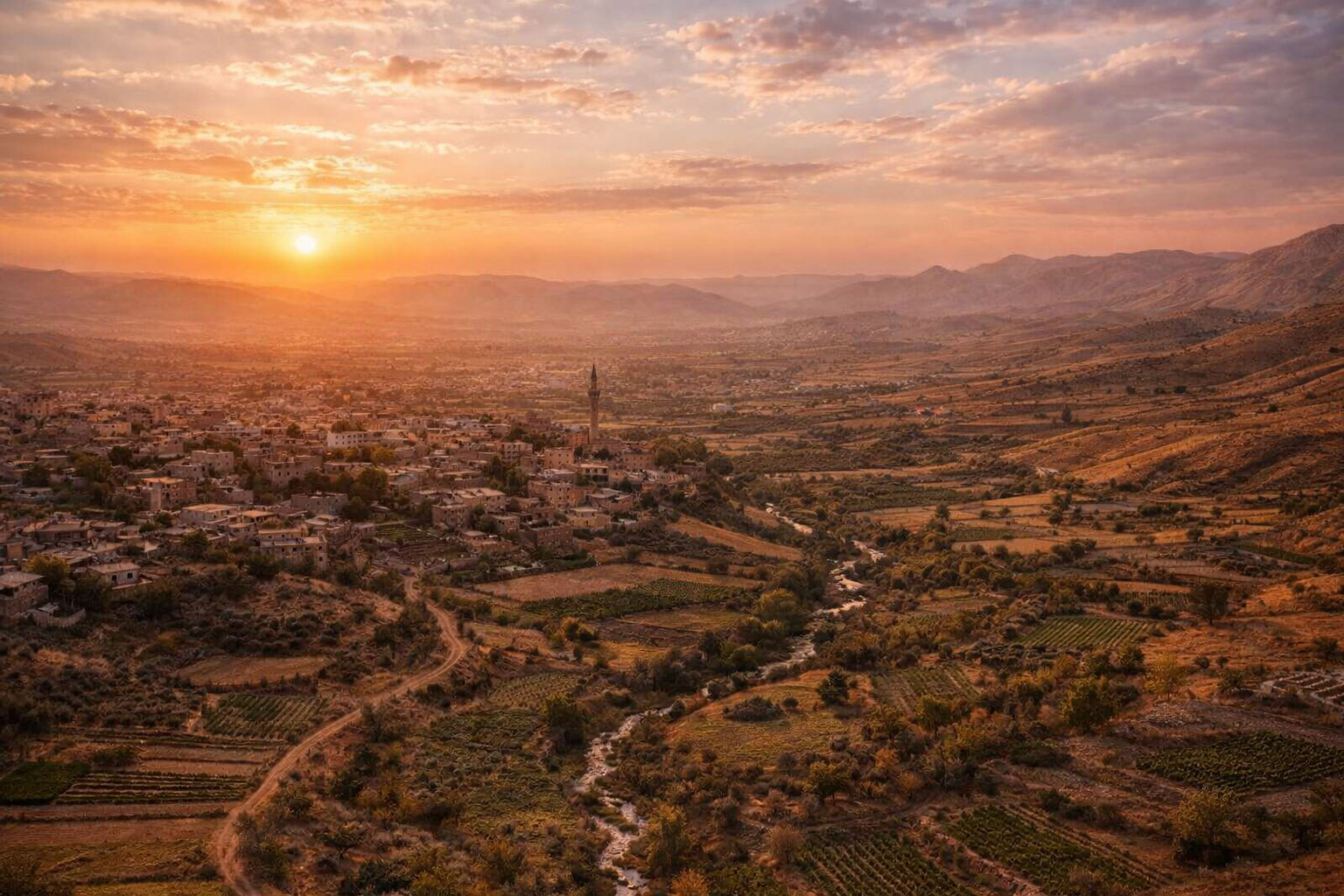
Rif Dimashq is the countryside region surrounding Damascus, known for its towns, agriculture, mountains, and rich Syrian cultural heritage.
Rif Dimashq Governorate, often translated as the Damascus Countryside or Rural Damascus, ranks among Syria’s most historically rich and geographically important provinces. It surrounds the city of Damascus in a wide semi-circle and forms a distinct region that connects ancient civilizations, fertile landscapes, and a dynamic modern identity. As a result, the governorate has long played a vital role in Syria’s political, cultural, and economic life.
A Land Defined by Strategic Location
Rif Dimashq Governorate lies in the southwestern part of the Syrian Arab Republic. It fully encircles the independent Damascus Governorate, which serves as the national capital. Covering approximately 18,032 square kilometers, the province stands among Syria’s larger administrative regions.
Moreover, Rif Dimashq borders several internal governorates. Homs lies to the north, Suwayda to the east, and Daraa and Quneitra to the south and southwest. In addition, the governorate reaches international borders with Lebanon to the west and Jordan to the south. This strategic position has consistently made Rif Dimashq a vital corridor linking coastal Syria, inland plains, and desert regions.
The administrative capital of the governorate is Douma. Historically and economically, Douma complements Damascus while maintaining its own urban identity and regional influence.
Geography and landscapes of Rif Dimashq
Rif Dimashq displays remarkable geographical diversity. In the east, semi-arid and desert landscapes dominate the terrain. Meanwhile, the western regions rise into the foothills of the Anti-Lebanon Mountains, creating a contrasting mountainous environment.
However, the most distinctive natural feature remains the Ghouta oasis. Fed by the Barada River, the fertile alluvial plains of Ghouta have sustained agriculture for thousands of years. Consequently, this green belt provided food security for Damascus during times of prosperity and hardship alike.
For centuries, the Ghouta formed a natural shield of orchards, fields, and waterways. Therefore, it became an essential foundation for the survival and growth of the ancient city of Damascus.
Rif Damascus : Cradle of Ancient Civilizations
Human settlement in Rif Dimashq extends deep into prehistory. Archaeological evidence indicates continuous habitation since the Neolithic period. Indeed, the broader Damascus region ranks among the oldest continuously inhabited areas in the world.
In antiquity, Rif Dimashq belonged to the cultural and political sphere known as Damascena. Classical sources used this term to describe the territory surrounding Damascus. Because of its position between Africa and Asia, the region naturally evolved into a crossroads of civilizations.
During the late second millennium BCE, the Aramaeans established a powerful kingdom centered on Damascus. The state of Aram-Damascus exercised political and economic influence across the Levant until Assyrian forces conquered it in the 8th century BCE.
Successive empires and cultural classes in Rif Dimashq
Over time, Rif Dimashq experienced repeated waves of conquest and transformation. Each era left lasting marks on the landscape and society:
-
Assyrian rule in the 8th–7th centuries BCE ended local independence.
-
Neo-Babylonian and Achaemenid Persian control followed, integrating the region into wider imperial systems.
-
Hellenistic rule, beginning in 333 BCE after Alexander the Great’s conquest, introduced Greek urban planning and cultural elements.
-
Roman and Byzantine periods further shaped the countryside through infrastructure, Christianity, and administration.
Beyond Damascus itself, towns such as Maaloula and Saidnaya preserve ancient monasteries, churches, and fortifications. These sites clearly illustrate the convergence of Roman, Byzantine, Islamic, and medieval traditions across Rif Dimashq.
The cultural and economic importance of the Rif Dimashq
For millennia, Rif Dimashq’s fertile plains supported intensive agriculture. Farmers cultivated grains, fruits, and vegetables that supplied Damascus and surrounding trade networks. As a result, agricultural surplus encouraged commerce and population growth.
At the same time, the governorate developed as a center of cultural diversity. Its villages and towns historically hosted Arabs, Aramaic-speaking communities, and various religious groups. Consequently, this diversity enriched Syria’s cultural fabric and strengthened social exchange.
A Region Shaped by Conflict and Power
Throughout history, Rif Dimashq’s strategic value attracted competing powers. In antiquity, Assyrian, Roman, and Byzantine empires fought to control the region. Each empire sought dominance over the routes and resources surrounding Damascus.
In the modern era, the countryside again became a strategic zone. During World War I, battles in areas such as Kawkab on the Ghouta plains formed part of the Allied campaigns that ended Ottoman rule in the Levant.
Although the governorate has experienced profound challenges in the 21st century, this overview intentionally focuses on its long historical trajectory beyond recent conflict. Nevertheless, Rif Dimashq’s modern experience continues to reflect its enduring strategic importance.
Discover more details about the Damascus countryside on our YouTube channel.

Present-Day Rif Dimashq: Continuity and Change
Today, Rif Dimashq remains a vital administrative and economic region within Syria. Its districts contribute to agriculture, industry, and education. Numerous schools and universities serve students from both rural and urban communities.
Despite social and political changes, the governorate still preserves deep historical continuity. Town names, architectural styles, and agricultural traditions echo centuries of human settlement and adaptation.
Quneitra: History, Culture and Facts About Syria’s Golan City
Conclusion
Rif Dimashq Governorate embodies a layered historical narrative stretching from prehistory to the present. Its fertile lands nourished ancient civilizations, while its location linked empires and cultures across the Near East.
Although political dynamics have shifted over time, the governorate’s identity remains rooted in geography, history, and resilience. Whether viewed through ancient settlements, imperial struggles, or everyday rural life, Rif Dimashq stands as a living testament to Syria’s enduring historical depth and cultural richness.
Aleppo: History, Culture and Facts About Syria’s Oldest Cities
Leave a Reply