
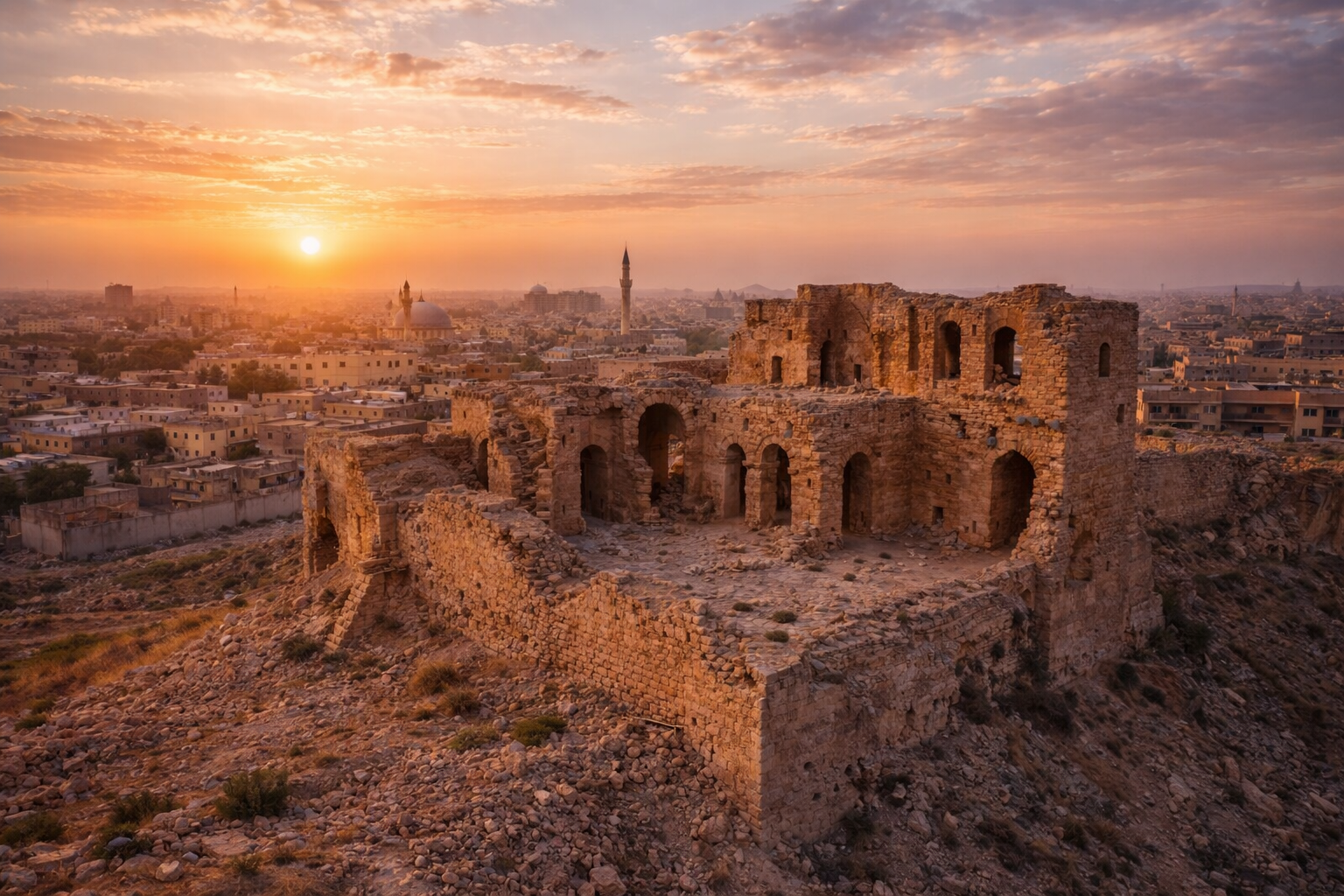
Qasr al-Banat in raqqa is a historic palace located in Raqqa, Syria, known for its unique architecture and ancient history dating back centuries.
Nestled in the ancient city of Raqqa on the banks of the Euphrates River lies an evocative testament to Syria’s rich Islamic heritage: the Maidens’ Palace, locally known as Qasr al-Banāt (قصر البنات). Though now in ruins and scarred by decades of conflict, this historic architectural marvel still offers a window into the grandeur of the Abbasid era—a period when Raqqa was not only a regional capital but also a favored residence of one of the most celebrated caliphs in Islamic history.
Qasr al-Banat in raqqa : A Jewel of Early Islamic Architecture
The Maidens’ Palace is a brick palace complex whose origins are tied to the broader story of Raqqa’s rise as a prominent city under the early Abbasid caliphate. Founded as a strategic and cultural hub in northern Syria, Raqqa—originally known as ar-Rāfiqa—served as a summer residence and administrative post for rulers during the late 8th century. Although medieval sources report earlier palatial constructions nearby, the surviving remains of Qasr al-Banat in raqqa as we know them mainly date from the 12th century CE, reflecting extensive renovations during the local Zengid and Ayyubid periods.
Architecturally, the palace is remarkable for its four-iwan layout—a design that features a large central courtyard surrounded on all sides by vaulted halls (iwans), porticoes, and ancillary rooms. This configuration harks back to Iranian design influences that were relatively rare in 12th-century Syria, especially in secular buildings. Each iwan would have opened onto the courtyard, which originally contained a fountain at its center—a symbol of tranquility and leisure in Islamic residential architecture.
The use of baked brick with decorative patterns, along with the evidence of intricate stucco and mosaic work, speaks to the palace’s former sophistication and the sophisticated tastes of its patrons and occupants. Scholars suggest that the palace may have served not only as a summer residence for members of the elite, possibly including women of the Abbasid household (hence the evocative name Palace of the Maidens), but also as a site for gatherings, study, and cultural activities.
The historical significance of the Qasr al-Banat in raqqa in Raqqa: from the Abbasid era to contemporary awareness
In the Abbasid period, Raqqa was more than a provincial town—it was a second capital of the caliphate for several years, especially during the reign of Caliph Harun al-Rashid (r. 786–809), who famously made it his base for some twelve years. During this time, the city flourished and became a nexus of politics, culture, and commerce in the Islamic world. Qasr al-Banat in raqqa as part of this urban fabric, epitomized the city’s elevated status and served as a symbol of power and refinement.
Over time, structural changes, natural deterioration, and repeated reconstructions—particularly after an architectural collapse in the 11th century—altered its original form. Yet even in its rebuilt form, Qasr al-Banat in raqqa remained a testament to Raqqa’s enduring urban identity, reflecting shifts in architectural styles from the Abbasid through the Zengid and Ayyubid eras.
Archaeological interest in the site dates back to the early 20th century, with noted explorers such as Ernst Herzfeld, Friedrich Sarre, and Gertrude Bell documenting its ruins. Later excavations by Syrian archaeologists in the 1970s and 1980s helped clarify its layout and historical depth, albeit much remains to be learned due to limited research and preservation resources.

Despite these challenges, Qasr al-Banat in raqqa continues to resonate culturally—not simply as ruins but as an enduring emblem of Raqqa’s layered history, bridging early Islamic grandeur, medieval architectural brilliance, and contemporary struggles to protect Syria’s heritage.
Where is the Girls’ Palace located in Raqqa and how to get there?
The Maidens’ Palace is located in the southeastern area of Raqqa, near the archaeological precinct that includes the remains of the old city walls and the Bab Baghdad (Baghdad Gate)—a significant ancient gateway through which many historic processions and daily life once flowed. The palace ruins lie approximately 400 meters (about a quarter-mile) north of the Baghdad Gate, just west of where the old city’s eastern wall used to stand.
Discover details about the topic of Qasr al-Banat in Raqqa on our YouTube channel.
Travel Tips for Visitors
- Getting There: From downtown Raqqa, local taxis or car services can transport you toward the old city archaeological zone. The site is not a formal museum but an open archaeological area, so plan for a guided visit if possible through local heritage organizations or community guides.
- Access Considerations: Parts of the area may still be undergoing clearance and stabilization works, and caution is advised due to uneven terrain and ongoing urban reconstruction.
- Nearby Landmarks: Visitors often combine a trek to Qasr al-Banāt with sights such as the Bab Baghdad ruins, the remnants of the Old City wall, and other Abbasid sites around Raqqa.
Why Qasr al-Banat in raqqa Matters Today
Although the Maidens’ Palace stands in partial ruin, its historical and architectural significance is profound:
- Architectural Value: Its four-iwan layout and brick ornamentation reflect advanced design principles that connect Syrian Islamic architecture to broader regional trends, including Persian influences.
- Cultural Identity: As a relic of Raqqa’s golden era under the Abbasids, the site embodies centuries of urban life, governance, and cultural exchange along the Euphrates.
- Heritage Preservation: Its current state highlights the urgent need to preserve Middle Eastern archaeological treasures endangered by war and neglect.
In a region where history and modern conflict often intersect, Qasr al-Banāt reminds us that beyond headlines and geopolitics lies a legacy of human achievement that transcends time—waiting to be understood, respected, and restored for future generations.
Raqqa: History, Culture and Facts About Syria’s Euphrates City
Leave a Reply