
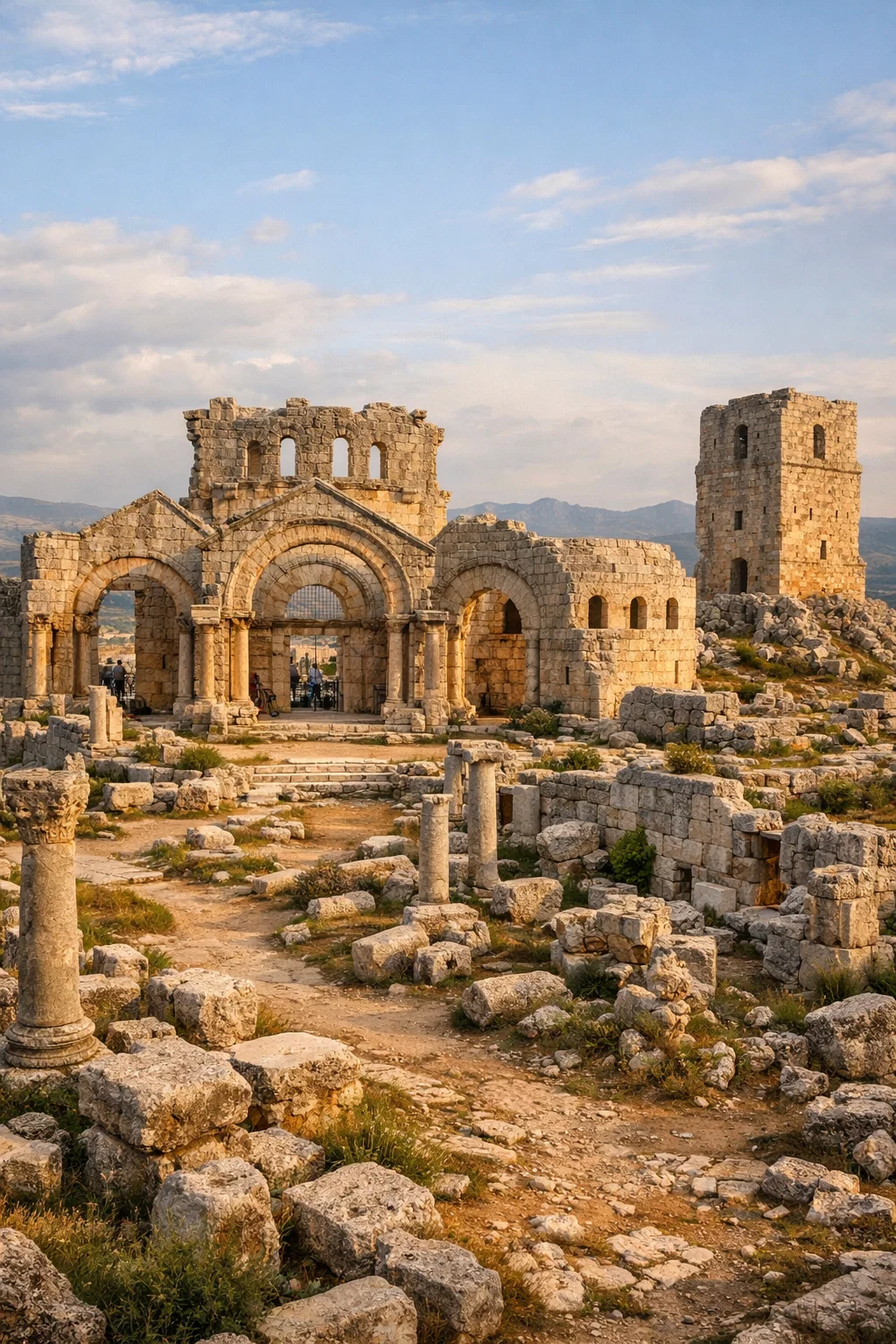
Qalat Simaan (Castle of Saint Simeon): A Landmark of Early Christian Architecture
Introduction
Located on a rocky hilltop in the northwestern part of Aleppo Governorate, Qalat Simaan, also known as the Citadel of Saint Simeon Stylites, ranks among the most remarkable archaeological sites in Syria and the Middle East. Despite its name, the site was not originally a military fortress. Instead, it was conceived as a vast religious complex centered on devotion and pilgrimage.
At its core, Qalat Simaan is a monumental church and monastic ensemble. It was constructed around the pillar on which Saint Simeon Stylites spent decades in ascetic isolation. As a result, the site reflects a unique combination of spiritual devotion, architectural innovation, and early Christian pilgrimage culture.
Even today, the surviving remains testify to the sophistication of Byzantine architecture and the deep religious traditions of the 5th century AD.
Historical Background
The story of Qalat Simaan begins with Saint Simeon Stylites, a Syrian Christian ascetic born around 389 AD. Seeking spiritual perfection, Simeon adopted an extraordinary form of devotion by living atop a stone column. He remained there for nearly forty years, dedicating his life to prayer, fasting, and meditation.
Over time, his reputation spread far beyond Syria. Consequently, pilgrims from across the Byzantine world traveled to witness his ascetic life and seek spiritual counsel. Clergy, scholars, and ordinary believers all gathered at the site, transforming it into an important religious destination.
Following Saint Simeon’s death in 459 AD, the Byzantine Emperor Zeno ordered the construction of a grand religious complex to honor his legacy. Building began around 476 AD and continued for approximately fourteen years, reaching completion in 490 AD.
Architectural Innovation and Expansion
The resulting structure was revolutionary for its time. The church followed a cruciform plan, with four basilica wings radiating outward from a central octagonal courtyard. At the heart of this octagon stood the remains of Saint Simeon’s column, making it the spiritual focal point of the entire complex.
This architectural design not only facilitated large numbers of pilgrims but also symbolized the central role of Simeon’s ascetic life in early Christian thought. Moreover, the scale of the complex demonstrated the importance of pilgrimage in Byzantine religious culture.
During the early medieval period, the site continued to evolve. Additional structures were constructed, including monasteries, pilgrim hostels, baptisteries, and service buildings. As political and military conditions shifted, parts of the complex were fortified. Consequently, the site gradually became known as Qalat Simaan, or the “Citadel of Simeon.”
Religious and Cultural Significance
Qalʿat Simʿān represents far more than an architectural achievement. It stands as one of the earliest large-scale pilgrimage centers in Christian history. The site illustrates how ascetic practices influenced religious architecture, urban planning, and devotional travel.
Furthermore, it highlights Syria’s central role in the development of early Christianity. Long before Europe became the heartland of Christian architecture, sites like Qalʿat Simʿān shaped religious expression in the eastern Mediterranean.

Location and Architecture of Qalat Simaan
Qalat Simaan is located about 30 kilometers (19 miles) northwest of Aleppo, near the town of Dāret ‘Izzah, on Mount Simeon. This limestone massif is part of the distinctive landscape of northern Syria and was home to many early Christian settlements.
Because of its elevated position, Qalat Simaan offered both symbolic and practical advantages. It dominated the surrounding countryside and was visible from great distances, reinforcing its importance as a pilgrimage destination.
Cultural and Historical Significance of Qalat Simaan
Qalat Simaan was once one of the most important pilgrimage sites in Syria, drawing Christians from across the Byzantine world and beyond. Its unique design and function as a center of worship, asceticism, and communal life made Qalat Simaan a landmark of early Christian architecture and devotion.
In addition to its spiritual value, Qalat Simaan reflects cultural interaction between local Syrian Christian traditions and Byzantine imperial patronage. The remains of the basilica, baptistery, and surrounding monastic structures provide valuable insights into early church architecture and the role of asceticism in late antiquity.
Qalat Simaan in the Islamic Era and Later History
After the Arab conquest of Syria in the 7th century, Qalat Simaan continued to be revered and maintained under Islamic rule, often preserved by local Christian communities in accordance with the tolerant traditions of the early Islamic state. Periodically, Byzantine forces would reoccupy and fortify Qalat Simaan, giving it more defensive traits and contributing to its later name as a citadel.
Over the centuries, earthquakes — especially those in 526–528 AD — inflicted severe damage upon Qalat Simaan’s structures. Later political and military changes diminished its military importance, yet Qalat Simaan remained an important archaeological and cultural heritage location.
Modern History and Present Condition of Qalat Simaan
In modern scholarship, Qalat Simaan forms part of the famous Dead Cities of Northern Syria, a group of ancient settlements recognized by UNESCO as a World Heritage Site. These ruins preserve exceptional examples of late Roman and Byzantine architecture.
Nevertheless, the Syrian Civil War severely disrupted access to Qalat Simaan and other heritage sites. Security conditions have fluctuated, limiting tourism and archaeological activity. As of 2026, no officially published ticket prices or permanent visiting schedules for Qalat Simaan can be reliably confirmed. Therefore, visitors are strongly advised to consult updated local sources before planning a visit.
Video about Simeon Castle on our YouTube channel
How to Visit and Access
From the historic city of Aleppo, visitors would traditionally take a road northwest toward Dāret ‘Izzah and then approach the hilltop where Qalat Simaan stands. The route offers panoramic views of the surrounding countryside and integrates well with visits to other northern Syrian archaeological sites.
Due to regional security considerations, travel logistics can vary widely, so prospective visitors should consult current travel advisories and local authorities or tour operators familiar with the region’s conditions.
Shayzar Castle (Chizar): History and Facts About the Ancient Fortress in Hama
Conclusion
Qalat Simaan remains one of northern Syria’s most remarkable heritage sites — not only for its architectural and historical significance but also as a living testament to traditions of faith, pilgrimage, and cultural exchange that shaped the ancient Near East. Whether studied by historians or experienced firsthand by travelers, its legacy endures as a symbol of devotion and human creativity spanning more than fifteen centuries.
Masyaf Castle: History and Facts About the Famous Ismaili Fortress in Syria
Leave a Reply