
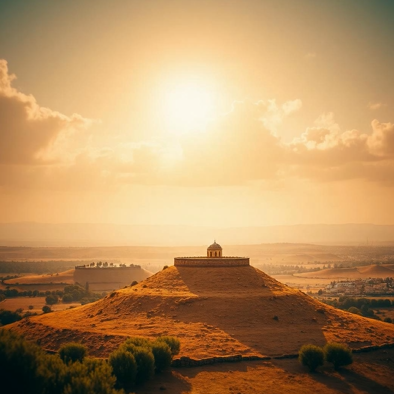
Qadesh: The Ancient Crossroads of Empires in the Homs Countryside
Nestled on the eastern banks of the Orontes River in western Syria’s Homs Governorate lies one of the most historically significant yet often overlooked archaeological sites of the ancient Near East: Tell el-Nabi Mend, better known to historians and archaeologists as Qadesh or Kadesh. This remarkable site, straddling millennia of history — from the earliest Neolithic settlements to a key strategic battlefield of Bronze Age powers — represents both a window into ancient civilization and a reminder of the fragility of cultural heritage.
🗺️ Where is Tell el-Nabi Mend (Qadesh)?
Tell el-Nabi Mend (sometimes transliterated as Tell Nebi Mando or Tell Nebi Mend) is a large archaeological tell — a mound formed by long-term human settlement — in central western Syria, about 24–30 km southwest of the city of Homs. It stands near the modern village of Tell al-Nabi Mando, on the fertile banks of the Orontes River, close to the town of al-Qusayr.
The site rises roughly 30 meters above the surrounding plain, making it a naturally prominent landmark. Its position near the confluence of the Orontes River and its tributary — the Muqadiyah — gave it strategic significance in the ancient world.
📜 History: Qadesh from Prehistoric Times to the Bronze Age, a Center of Power
Ancient Roots
Archaeological evidence shows that the mound upon which Qadesh was built was occupied intermittently from the Neolithic period onward, with some material dating as far back as the seventh millennium BCE. These earliest settlements laid the groundwork for one of the ancient Near East’s most enduring urban centers.
During the Early and Middle Bronze Ages, the site developed into a culturally and economically significant city in the Levant. Its name — Qadesh — likely derives from a West Semitic root meaning “holy,” reflecting its longstanding prominence in regional culture and geography.
Qadesh in the Late Bronze Age and an ancient world battlefield
Qadesh’s greatest claim to fame comes from the Late Bronze Age (circa 1500–1200 BCE), when it became a focal point of competing empires. The city was heavily fortified and engaged in shifting alliances and conflicts between powerful neighbors — especially the Egyptian and Hittite empires.
In the 13th century BCE, near Qadesh’s walls on the plains by the Orontes, took place the Battle of Kadesh — perhaps the most famous and well-documented ancient battle in history. In 1274 BCE, the armies of Ramesses II of Egypt and Muwatalli II of the Hittite Empire clashed in what is often described as the largest chariot battle ever fought.
Though both sides claimed victory, the result was essentially a stalemate that led to a formal peace treaty, widely considered the earliest surviving diplomatic peace agreement in human history.
Classical and post-classical periods of Qadesh
After the Bronze Age, Qadesh continued as a settlement into the Iron Age and later under Hellenistic and Roman influence. Around the 3rd century BCE, the area became associated with the Roman outpost known as Laodicea ad Libanum, reflecting shifts in political and cultural power.
🏛️ Archaeological Work and Key Discoveries
Excavations at Tell el-Nabi Mend began in the early 20th century, with a French team led by Maurice Pezard uncovering important early Bronze Age layers.
From 1975 to 1995, archaeologists from the University College London Institute of Archaeology directed extensive excavations under Peter Parr. These digs revealed multiple occupation layers, ranging from the Middle Bronze Age through the Late Bronze Age, and unearthed notable finds such as:
- Cuneiform tablets, confirming the site’s identity as ancient Qadesh.
- Syro-Hittite cylinder seals and terracotta figurines.
- A fragmentary stele of Egyptian Pharaoh Seti I.
These artifacts provide a rich picture of the city’s complex political and cultural life over centuries.

🌍 Why Qadesh Matters
A Strategic Crossroads
Qadesh’s location at the edge of the Homs Gap — a natural transit corridor linking the Mediterranean coast to inland Syria and beyond — made it integral to ancient trade and military logistics. Control of Qadesh meant influence over routes connecting Egypt, the Levant, Anatolia, and Mesopotamia.
Military History and Global Legacy
The Battle of Kadesh remains a cornerstone event in the study of ancient warfare. Its scale, documentation (especially in Egyptian reliefs and inscriptions), and legacy in diplomacy make Qadesh a landmark for historians and archaeologists alike.
Continuity and Transformation
Beyond its military legacy, the site illustrates the evolution of urban settlement across epochs — from early village life to a fortified city and then into the classical world. This continuity offers scholars vital insights into shifting patterns of culture, economy, and governance.
🕰️ Present-Day Significance & Challenges
Today, Tell el-Nabi Mend lies near a small modern village of just over a thousand people.
Despite its heritage status, the site has faced damage during the Syrian civil conflict, including desertion, looting risks, and infrastructure destruction that complicates archaeological work and preservation efforts.
Nonetheless, its importance for Syrian cultural memory, ancient history education, and regional tourism potential remains profound — if peace and stability return to the area.
🚗 How to Reach Tell el-Nabi Qadesh
Accessing Qadesh today (based on historical travel routes):
- From Homs: Take a southwest route toward al-Qusayr — approximately 24–30 km.
- Local roads and tracks lead toward the village of Tell al-Nabi Mando, adjacent to the tell itself.
- The site lies near the Orontes River, and footprints of ancient ruins should be visible from elevated sections of the mound.
Also watch a video about Tell Nabi Mend (Qadesh) on our YouTube channel
Note: Due to the region’s political situation and safety considerations, anyone wishing to visit should consult up-to-date travel advisories and local authorities before planning a trip.
Margat Castle (Al-Marqab): History and Facts About Syria’s Crusader Fortress
✨ Conclusion
Tell el-Nabi Mend — ancient Qadesh — stands as a powerful symbol of Syria’s deep historical layers. From prehistoric settlements to imperial battlefields, its story spans millennia.
Ultimately, Qadesh is more than an archaeological site. It is a crossroads of civilizations and a lasting witness to humanity’s shared past.
Leave a Reply