
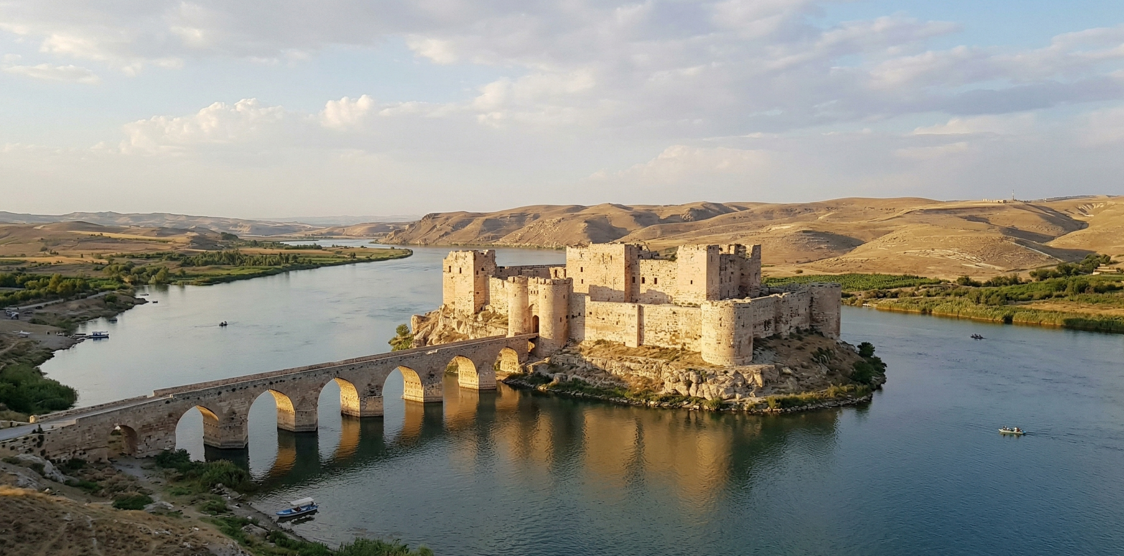
Najm Castle (Manbij): A Strategic Fortress Over the Euphrates River
Location and Strategic Importance of Najm Castle
Najm Castle stands on the eastern bank of the Euphrates River near Manbij in northern Syria. The fortress rises on a prominent hill overlooking one of the most important river crossings in the region.
Because of this elevated position, Najm Castle controlled movement between eastern and western territories. The Euphrates River acted as both a natural barrier and a major trade route. As a result, the castle played a critical role in regulating trade and military passage.
Moreover, the surrounding terrain enhanced its defensive strength. Steep slopes made direct attacks difficult, while the height allowed defenders to monitor wide areas. Therefore, Najm Castle functioned as both a fortress and an observation point.
In addition, the site connected key routes linking Aleppo with eastern regions. Controlling the castle meant controlling a major corridor in northern Syria. Consequently, it became a central stronghold in regional strategy.
History of Najm Castle
Najm Castle dates back to the medieval Islamic period and is closely associated with the rule of Saladin in the late 12th century.
During that time, Syria experienced frequent conflicts. Rulers built strong fortifications along rivers and trade routes to secure their territories. Najm Castle was part of this defensive network.
Unlike smaller outposts, the castle served as a major fortress. It supported both military operations and administrative control. In addition, it helped protect caravans moving between Syria and Mesopotamia.
During the Ayyubid and later Mamluk periods, the fortress remained an important defensive site. It contributed to maintaining control over northern Syria and safeguarding key routes.
However, with changes in warfare and political structures, the importance of such castles declined. During the Ottoman period, Najm Castle gradually lost its strategic role.
Without continuous maintenance, the structure began to deteriorate. Over time, natural factors contributed to its partial destruction.
Architecture of Najm Castle
The architecture of Najm Castle reflects strength and strategic design. Builders used large stone blocks to construct thick defensive walls capable of resisting attacks.
The layout follows the natural contours of the hill. This irregular design improved both stability and defense. As a result, the fortress became more difficult to access and attack.
The castle likely included multiple defensive layers. Outer walls and inner sections worked together to provide strong protection. Towers were placed at key points to allow wide observation of the Euphrates River and surrounding areas.
Inside, the castle contained essential spaces such as soldier quarters, storage rooms, and administrative areas. Open courtyards provided space for daily activities.
Water access was crucial. In addition to its proximity to the river, the castle likely included internal storage systems to ensure supply during sieges.
Today, large sections of the structure still stand. The remaining walls and towers clearly show the original scale and strength of the fortress.
Why Najm Castle Matters Today
Najm Castle is one of the most important medieval fortresses in northern Syria. Its location along the Euphrates River highlights the importance of river defense systems in history.
In addition, the castle provides insight into Ayyubid military architecture. It shows how geography and engineering were combined to create effective defensive structures.
Moreover, the site reflects the historical importance of Manbij as a regional hub. Its position along trade routes made it a key center in economic and military networks.
Today, preserving Najm Castle helps protect an important part of cultural heritage. It also creates opportunities for tourism and education.
How to Visit Najm Castle
Visitors can reach Najm Castle by traveling from Aleppo toward Manbij. From there, local roads lead to the castle near the Euphrates River.
The site is relatively accessible compared to mountain fortresses. However, exploring it may involve walking on uneven ground. Comfortable shoes are recommended.
Visitors should also carry water, especially during warm seasons. The open landscape provides limited shade.
Spring and autumn are the best times to visit. These seasons offer moderate temperatures and better conditions for exploration.
As always, checking local conditions before traveling is essential. Accessibility may vary depending on the situation. A local guide can provide valuable historical context and improve the experience.
Conclusion
In conclusion, Najm Castle stands as a powerful symbol of medieval strategy and strength. Its position above the Euphrates River made it a key point for controlling movement and protecting trade routes.
Because of its strategic importance, the castle played a major role during the Ayyubid and Mamluk periods. Over time, it declined and became a historical ruin.
However, its remains still reflect its former power and significance. The fortress tells a story of military planning, geographic advantage, and historical change.
Today, Najm Castle offers a unique opportunity to explore one of Syria’s most significant heritage sites. It remains a landmark that deserves recognition and preservation.
Shmemis Castle: The Historic Fortress Near Salamiyah in Syria
Leave a Reply