
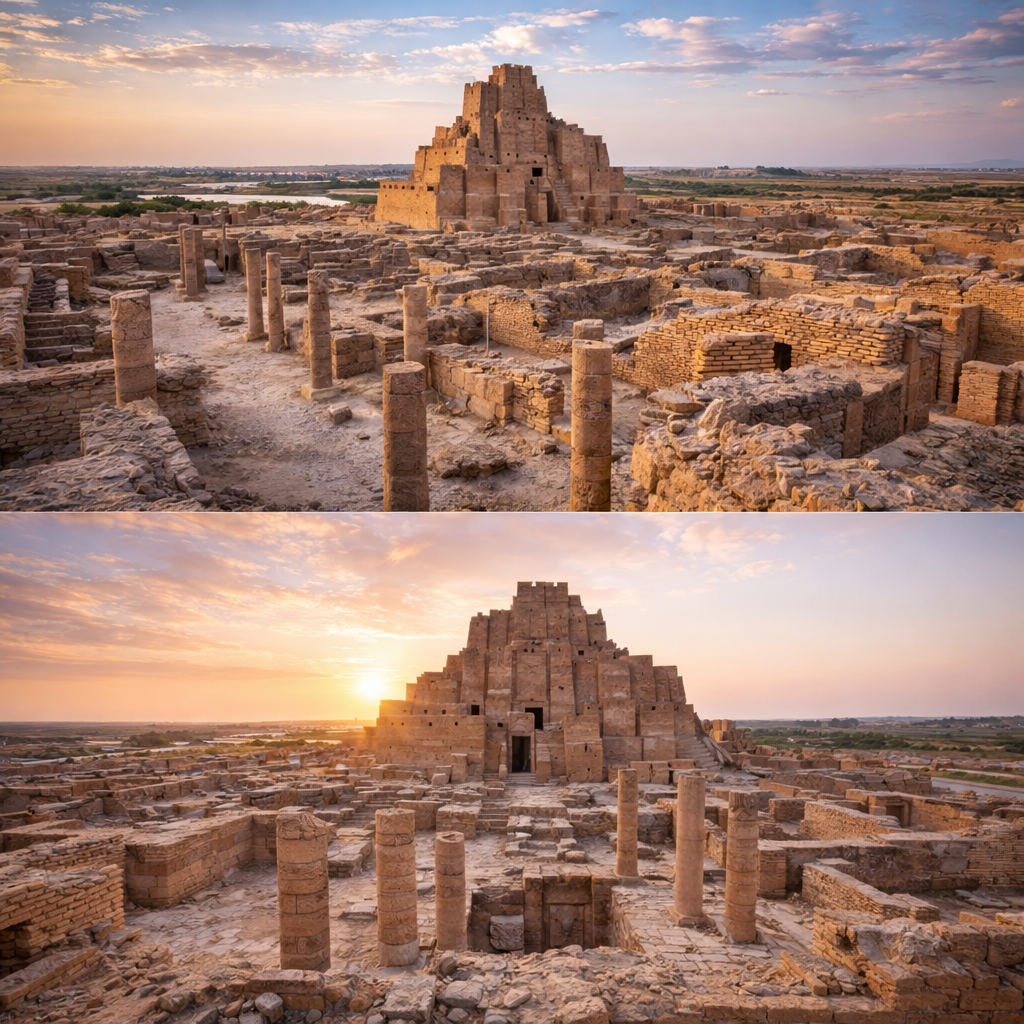
Mari is an ancient city in eastern Syria, located near the Euphrates River, known for its great palace, archives, and role in Bronze Age civilization.
Along the fertile banks of the Euphrates River in eastern Syria lies the ancient city of Mari. Once a powerful capital and cultural center, archaeological city is now largely in ruins. Despite this, it remains one of the most important archaeological sites for understanding early civilization.
Known locally as Tell Hariri (تل الحريري), Mari’s history stretches back more than 5,000 years. The city experienced periods of great prosperity, violent destruction, renewal, and eventual abandonment.
Where Is Mari? – Geography and Setting
Mari stands on the western bank of the Euphrates River in today’s Deir ez-Zor Governorate. It lies about 11 km northwest of modern Abu Kamal, near the Syrian–Iraqi border.
The site sits on a natural terrace above the floodplain. This location protected the city from seasonal flooding while providing constant access to water. Mari also occupied a strategic position between Mesopotamia, the Levant, and Anatolia. This made it a vital crossroads for trade, diplomacy, and cultural exchange.

A Long and Layered History
Mari’s origins date back to the 5th millennium BCE, but its major rise began around 2900 BCE during the Early Bronze Age. Over time, the city went through repeated cycles of growth, destruction, and rebuilding.
Early City and Growth (c. 2900–2400 BCE)
During its earliest phase, archaeological city became a major urban and commercial center. It linked distant regions through trade networks. This first golden period ended when the city was destroyed in the mid-3rd millennium BCE.
Second and Third Kingdoms
archaeological city was later rebuilt and fortified. It became the capital of a powerful East Semitic state and clashed with neighboring cities such as Ebla. The city eventually came under the influence of the Akkadian Empire.
After Akkad’s fall, local rulers known as the Shakkanakku governed archaeological city . They preserved its importance as a regional center.
Golden Age – The Reign of Zimri-Lim (c. 1775–1761 BCE)
archaeological city reached its peak under King Zimri-Lim. His royal palace became the heart of a vast diplomatic and trade network. These connections extended to Babylon, Ebla, and beyond.
Thousands of clay tablets discovered in the palace archives reveal details about daily life. They document laws, trade, diplomacy, and politics across the ancient Near East.
Conquest and Decline
Mari’s prosperity ended when Hammurabi of Babylon conquered and destroyed the city around 1760 BCE. Although limited occupation continued under later powers, archaeological city never recovered its former status. It was eventually abandoned during the Hellenistic period.
Why Mari Matters — Past and Present
Mari was more than just a city. It offers a rare window into early civilization.
A Treasure Trove of Knowledge
One of Mari’s greatest legacies is its archive of tens of thousands of clay tablets. These texts transformed modern understanding of Bronze Age politics, economics, and diplomacy.
Architectural Achievements
The Great Royal Palace of Mari, expanded under Zimri-Lim, may have included more than 260 rooms. Its frescoes, offices, and layout provide unique insight into palace life nearly 4,000 years ago.
Trade and Urban Planning
Mari thrived as a trade hub linking Sumer, the Levant, and Anatolia. The city’s canals and planned streets reflect advanced knowledge of urban infrastructure in an arid environment.
Mari in the Bronze Age
The Modern Fate of Mari
Excavations at Mari began in 1933, led by French archaeologist André Parrot. Archaeologists uncovered palaces, temples, homes, and countless artifacts now displayed in museums worldwide.
In the 21st century, the site has suffered greatly. Excavations stopped with the outbreak of the Syrian civil war. Mari endured looting and damage, as shown by satellite imagery. Despite this, scholars continue efforts to document and preserve what remains.
How to Reach Mari Today
Access to Mari is currently very limited due to security conditions in eastern Syria. In more stable times, reaching the site involved:
Flying to Damascus or Deir ez-Zor
Traveling by road toward Abu Kamal
Following local directions to Tell Hariri, about 11 km from the town
Because of its proximity to the border, travel requires permits and updated local guidance. Visitors should always consult official authorities and the Syrian Directorate-General of Antiquities and Museums.
A video about Mary is on our YouTube channel.
Because the site is near the Syrian-Iraqi border, travel requires permits and up-to-date local information from official authorities due to security considerations. Before planning a visit, always consult travel advisories and the Syrian Directorate-General of Antiquities and Museums for guidance.
Read also:
Qadesh: The Ancient Crossroads of Empires in the Homs Countryside
✨ In Conclusion
Mari may lie in ruins, but its story resonates across millennia. As a crossroads of trade, culture, and politics, it reveals how early civilizations interacted, governed, and imagined their world. From Zimri-Lim’s libraries to the palace walls that still whisper ancient secrets, archaeological city remains one of humanity’s greatest archaeological treasures — a testament to how our past shapes our present understanding of civilization itself.
Read also:
Old Raqqa City Wall: History and Facts About the Ancient Fortifications
Leave a Reply