
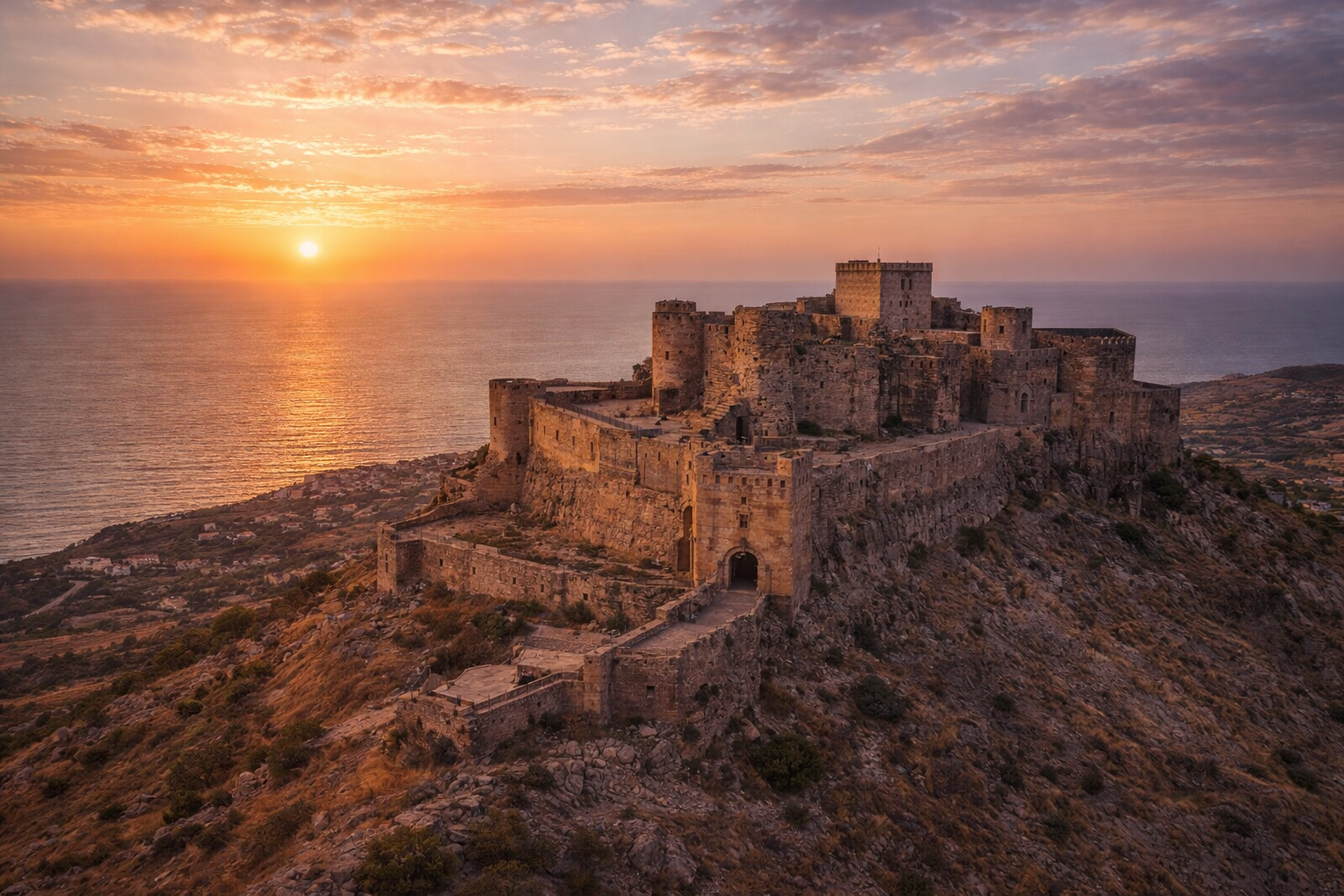
Margat Castle, also known as Al-Marqab Castle, is a historic medieval fortress located near Tartus in Syria, famous for its strong defenses and strategic location.
Nestled high above the Mediterranean shoreline in western Syria, Al-Marqab Castle (Arabic: قلعة المرقب) — also known to many visitors as Margat Castle — is one of the most evocative medieval fortresses in the Levant. Perched dramatically atop a volcanic hill overlooking the coastal town of Baniyas in Syria’s Tartus Governorate, this fortress stands as a testament to centuries of conflict, cooperation, and cultural exchange between empires, Crusader knights, and local dynasties.
Margat Castle: A watchtower with a view: Location and place
Margat Castle crowns a basalt hill some 360–370 meters above sea level, about 6 kilometers south of Baniyas and roughly 30 kilometers north of Tartus along Syria’s western coast. Its elevated position — formed by an extinct volcano — affords commanding panoramas of the Mediterranean Sea to the west, rolling hills to the east, and the fertile plains leading toward Homs and Hama inland.
The Arabic name Marqab means “watchtower” or “place of lookout,” perfectly reflecting the fortress’s role for more than a millennium: a strategic vantage point to observe sea traffic, defend coastal routes, and control access between inland Syria and the Mediterranean corridor.
Margat Castle: A Fortress Through the Ages: A Rich Historical Fabric
Al-Marqab’s history stretches back well before the Crusades, with archaeological and textual evidence indicating use as a lookout site possibly since Roman times, though little remains from that earliest period today. Its prominent location meant local Muslim rulers likely used it in the early Islamic period as a defense against Byzantine influence.
Crusader Stronghold (12th–13th Century)
While the earliest fortifications date to around 1062 CE, the castle rose to historical prominence during the Crusades. By the 12th century, Christian forces — most notably the Knights Hospitaller — fortified the site extensively, turning Marqab into one of the largest and most formidable Crusader castles in the region.
Under the Hospitallers, the castle became a logistical and military hub, guarding vital land and sea routes between Tripoli, Antioch, and inland territories. Its massive basalt walls, multi-tiered defenses, and internal facilities — including barracks, storerooms, cisterns, and a chapel — reflected advanced medieval military architecture designed to resist siege warfare and project power across the coast.
Legend has it that when Saladin marched against Crusader forces in the late 12th century — including after the pivotal Battle of Hattin — he chose not to lay siege to Marqab simply because its defenses were too strong.
Mamluk Conquest and Later Eras
In 1285, after years of Mamluk pressure on Crusader states, Sultan Qalawun captured Marqab following a determined siege that reportedly undermined part of the southern tower. The Hospitallers surrendered, withdrawing to coastal cities such as Tripoli and Tartus.
Under Mamluk rule, the fortress retained importance as a regional outpost and was repaired and maintained. During the Ottoman era, Marqab’s military significance waned, and it gradually transitioned from fortress to historic monument. Because of its durable basalt construction, many portions survived in relatively good condition even as centuries passed.
Architecture and Layout: A Fortress of Black Basalt
One of the most striking features of Margat Castle is its construction material: unlike the limestone or sandstone favored in many Crusader fortresses, Marqab is built predominantly from dark basalt stone. This gives its walls a dramatic, almost fossil-like appearance against the bright Mediterranean sky and lush green hills.
The fortress design incorporates:
- Thick Curtain Walls — reinforced by strong towers with interlocking fields of fire for defenders.
- Multi-Layered Gatehouse — with defensive features designed to foil attackers.
- Internal Courtyards & Halls — including barracks, storage, kitchens, and living quarters for knights and soldiers.
- Chapel and Religious Spaces — reflecting the Crusader presence and medieval religious life.
- Water Cisterns — essential for sustaining long sieges.
These elements make Al-Marqab not just a fortress but a self-contained medieval complex that embodied the practical and symbolic power of its builders.
What It Has Witnessed
Across its long existence, the castle has seen the ebb and flow of empires and armies, from Byzantine forces to Crusader knights, from Mamluk sultans to Ottoman governors. It bore witness to pivotal moments in the medieval struggle for control of the Levant’s coastal and inland arteries.
Though it avoided the widespread destruction seen at other Syrian heritage sites during modern conflicts, its age and exposure have left their mark. Still, it stands today as a monument to centuries of cultural intersections and historical drama.
Visiting Today: Practical Information

How to Reach Margat Castle
Visiting Al-Marqab Castle is relatively straightforward for travelers exploring Syria’s coast:
- By Car: From Tartus, it’s about a 40-minute scenic drive north along the coast toward Baniyas and the hills beyond.
- From Baniyas: Microbus or taxi services can take you up toward the castle road; the final ascent may involve a short hike depending on parking availability.
- Terrain: Wear sturdy walking shoes — the hilltop and internal ruined paths can be uneven. Bring water and sun protection in warmer months.
Discover more details about Margat Castle on our YouTube channel.
Opening Hours & Entrance Fee (2026)
- The castle is generally open to the public during daylight hours, often from 09:00 to around 17:00.
- Entrance Fee: While exact 2026 prices are not officially published, local visitor reports and tourism listings suggest a modest entrance charge applies — typically a small fee to support site maintenance and guided tours might be available.
- Guided Tours: Local guides can enhance your visit with rich stories and context about the castle’s history and architecture.
Qasr al-Banat in Raqqa: History and Facts About the Ancient Palace
Why Visit?
Al-Marqab Castle is more than just stone and walls — it’s a living chronicle of medieval coastal defense, a place where past and present meet in panoramic views, shaded chambers, and weathered battlements. Whether you’re a history buff, a photographer, or a traveler seeking off-the-beaten-path sites, this black basalt sentinel offers a powerful glimpse into Syria’s layered past.
Tartus: History, Culture and Facts About Syria’s Coastal City
Leave a Reply