
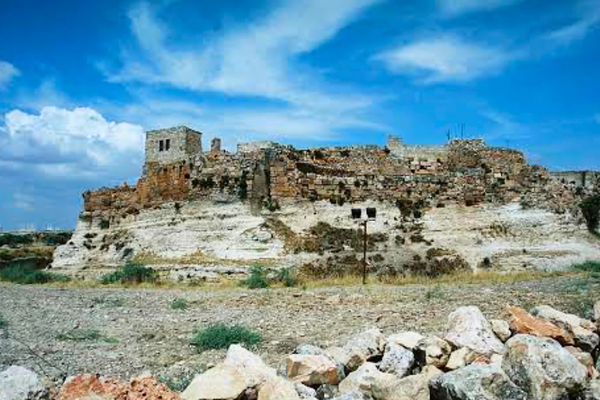
Maarrat al-Numan Castle is a historic fortress in northern Syria, located in the city of Maarrat al-Numan, known for its strategic location and long history.
Maarrat al-Numan Castle stands on a rocky limestone rise in northwestern Syria. It overlooks lands that witnessed centuries of movement, conflict, and trade. Although much of the structure has eroded, the castle still reflects the strategic and cultural importance of the region.
Today, Maarrat al-Numan Castle remains a silent witness to Syria’s layered past.
Location and Geography of Maarrat al-Numan Castle
Maarrat al-Numan lies between Aleppo and Hama, two major historic cities. This position placed the town on one of Syria’s most important ancient routes.
Maarrat al-Numan Castle rises on the town’s northwestern edge. Seasonal waters of the Hermas River once surrounded it on three sides. As a result, the castle enjoyed strong natural protection.
Moreover, a deep moat enhanced its defenses and limited direct access by enemies.

Historical Background of Maarrat al-Numan Castle
The history of Maarrat al-Numan Castle connects closely to the city itself. Ancient sources mention the settlement, known as Arra in Roman times, as early as the third century CE.
Over time, control shifted between Byzantine rulers, early Islamic powers, Crusaders, and later Islamic dynasties. Each era left traces on the castle and the town around it.
Importantly, the Great Mosque of Maarrat al-Numan reflects this layered past, as it rose on the site of an earlier church.
Maarrat al-Numan Castle in Medieval Conflicts
During the medieval period, the region became a stage for repeated conflicts. Maarrat al-Numan suffered greatly during the First Crusade in 1098. Historical accounts describe severe destruction after the city fell.
Although Maarrat al-Numan Castle was smaller than fortresses like Krak des Chevaliers, it still played a role in regional defense. Its elevated position allowed control over surrounding plains and travel routes.
Architectural Features of Maarrat al-Numan Castle
Today, visitors see only fragments of The historic castlee. Crumbling walls, traces of the moat, and limestone foundations define the site.
The castle once covered about 2,500 square meters. Its design focused on visibility, defense, and control rather than monumental size.
Over the centuries, locals reused stones for nearby buildings. Even so, the outline of the fortress remains clear.
Cultural and Historical Importance
For centuries, The historic castle shaped the city’s identity. It served both as a defensive structure and a civic landmark.
Meanwhile, the town became known for trade, culture, and learning. Nearby museums preserve mosaics from the Dead Cities, highlighting the area’s rich heritage.
In recent decades, conflict damaged many historical sites. Nevertheless, the medieval fortress continues to symbolize endurance and memory.
A video about Maaret al-Numan Castle is on our YouTube channel.
How to Visit the Castle
Travelers can reach the site by road from Aleppo or Hama. The city lies directly on the main north–south highway.
However, visitors should plan carefully. Local guides are strongly recommended due to changing security conditions. With proper preparation, exploring Maarrat al-Numan Castle becomes both safe and meaningful.
Qadesh: The Ancient Crossroads of Empires in the Homs Countryside
Conclusion — a Silent Witness to History
At first glance, Maarrat al-Numan Castle may appear as a collection of ruins. Yet behind its weathered stones lies a story of civilizations meeting at a historic crossroads. From ancient trade routes and medieval conflicts to present-day challenges of preservation, the castle connects past and present in a powerful way.
For historians, travelers, and curious readers alike, this ancient sentinel stands as proof that even in silence, history continues to speak.
Leave a Reply