
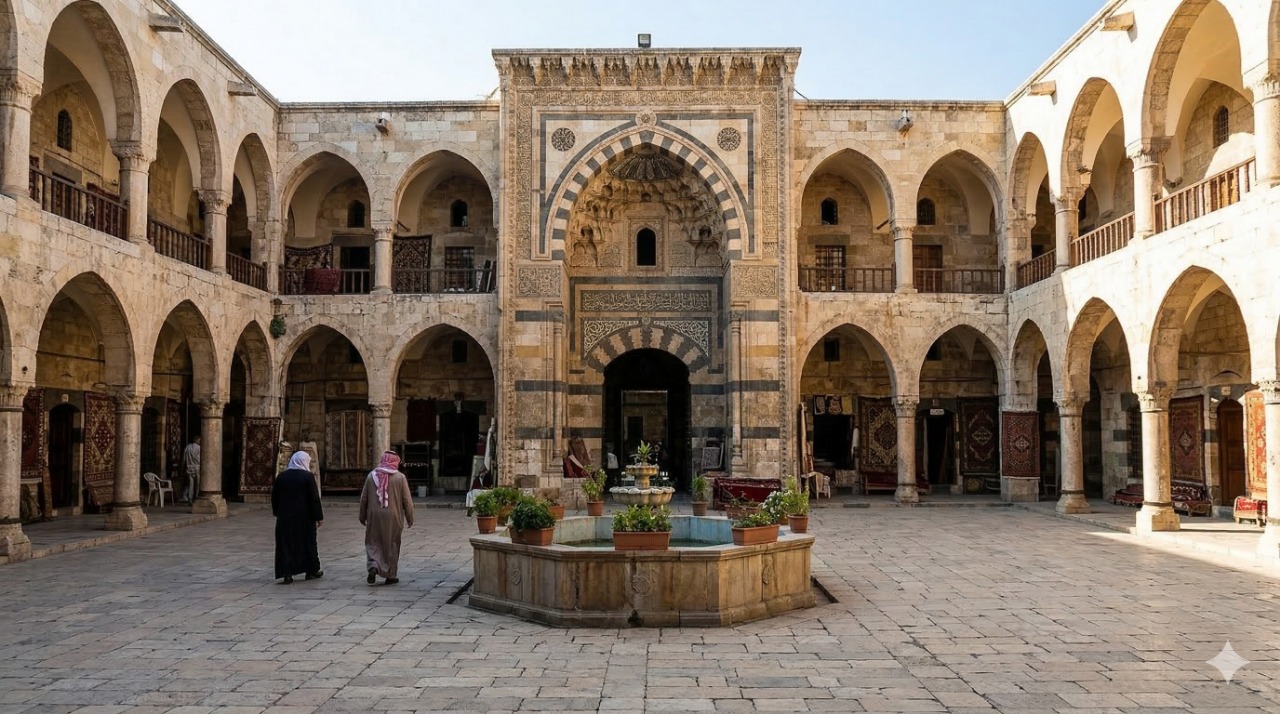
Khan al-Wazir: A Historic Caravanserai in the Heart of Aleppo
Introduction to Khan al-Wazir
Khan al-Wazir is one of the most beautiful historic caravanserais in the ancient markets of Aleppo. Merchants built this khan during the Ottoman period to support the thriving trade that once filled the city’s markets.
Today, Khan al-Wazir remains an important landmark inside the famous Old City of Aleppo. Visitors admire the elegant stone architecture and the peaceful courtyard that reflects the traditional design of Middle Eastern caravanserais.
Location of Khan al-Wazir
Khan al-Wazir lies in the historic souk district of Aleppo’s Old City. The khan stands close to the massive Citadel of Aleppo, which dominates the skyline of the historic center.
Because of this location, merchants easily transported goods between the markets and the city gates. The surrounding streets formed a network of markets that sold textiles, spices, metals, and traditional crafts.
Even today, visitors walking through the narrow alleys of the Old City can reach Khan al-Wazir within minutes from the citadel area.
History of Khan al-Wazir
The construction of Khan al-Wazir dates back to the late 17th century during the Ottoman era. The governor of Aleppo at the time ordered its construction to support commercial activity in the city.
During this period, Aleppo served as one of the most important trade centers between Asia, Europe, and the Mediterranean region. Merchants from many countries arrived in the city carrying silk, spices, fabrics, and precious goods.
Traders used Khan al-Wazir as a place to store merchandise and conduct business. The khan also provided accommodation for traveling merchants and their caravans.
Because of this role, the caravanserai quickly became an important part of Aleppo’s commercial life.
Architecture of Khan al-Wazir
Khan al-Wazir displays classic Ottoman caravanserai architecture.
Builders designed the structure around a large rectangular courtyard. Two levels of stone rooms surround the courtyard and create a symmetrical layout.
The ground floor served as storage rooms and workshops for merchants. The upper floor provided lodging spaces for traders and travelers.
Elegant stone arches, carved decorations, and wooden balconies add beauty to the structure. These architectural elements highlight the craftsmanship that once flourished in Aleppo.
Khan al-Wazir and Aleppo’s Traditional Markets
Khan al-Wazir formed part of the extensive market network of Aleppo.
Before the Syrian conflict, the markets of the Old City created one of the largest covered souk systems in the Middle East. These markets connected dozens of khans and specialized bazaars.
Merchants sold textiles, jewelry, spices, and handmade crafts in the surrounding streets. The Historic Ottoman Caravanserai served as a central meeting point where traders exchanged goods and information.
This commercial activity helped shape Aleppo’s reputation as a global trading city for centuries.
Damage During the Syrian War
The Syrian Civil War brought severe destruction to the historic markets of Aleppo.
Between 2012 and 2016, intense fighting damaged many sections of the Old City. Fires and explosions destroyed parts of the surrounding souks.
Fortunately, Khan al-Wazir suffered less damage than some nearby markets. However, the conflict still disrupted commercial activity and forced many shop owners to leave.
Restoration and Preservation
After the fighting ended, restoration projects began to repair the historic markets of Aleppo.
Specialists cleaned the stone surfaces and repaired damaged architectural elements. Workers also restored parts of the courtyard and surrounding rooms.
These efforts aim to protect The Historic Ottoman Caravanserai as part of the cultural heritage of the Old City of Aleppo.
Today, visitors can once again walk through the courtyard and admire the traditional architecture of this historic caravanserai.
How to Reach Khan al-Wazir
From Aleppo International Airport
Travelers arriving at Aleppo International Airport can reach the Old City by taxi or private car. The journey usually takes about 30 minutes depending on traffic.
By Taxi in Aleppo
Most visitors take a taxi to the citadel district. From there, they continue walking through the traditional markets.
Walking Through the Old Souks
The Old City streets are narrow and pedestrian-friendly. Visitors can easily reach The Historic Ottoman Caravanserai by walking through the souk near the Citadel of Aleppo.
Local residents and shopkeepers often help travelers find the historic khan.
Coordinates recorded on digital atlas services place it at approximately 36°12′0″ N, 37°9′36″ E—deep within the dense historic fabric of old Aleppo.
Why Khan al-Wazir Is Important
Khan al-Wazir remains a valuable part of Aleppo’s historical identity.
First, the building preserves the traditional architecture of Ottoman caravanserais.
Second, the site reflects the commercial importance of Aleppo during centuries of international trade.
Finally, the khan represents the resilience of the city and its cultural heritage.
Today, Khan al-Wazir stands as a reminder of the vibrant markets that once made Aleppo one of the greatest trading cities of the Middle East.
Khan al-Harir: The Historic Silk Caravanserai in Aleppo
Khan al-Wazir Aleppo: A Historic Ottoman Caravanserai in the Old City on Youtube
Leave a Reply