
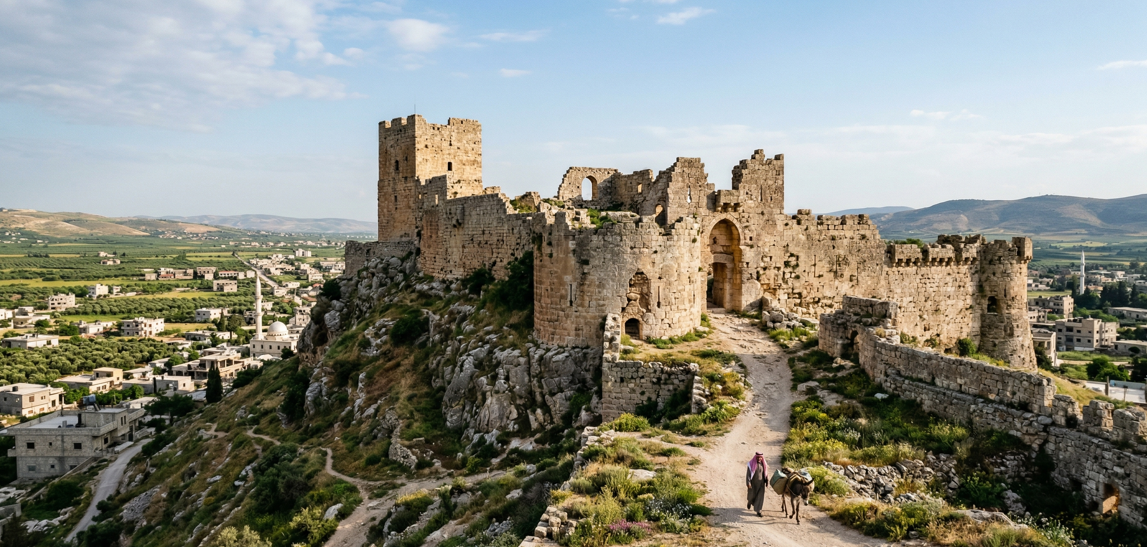
Kafranbel Castle (Kafranbel): A Hidden Fortress in the Idlib Highlands
Location and Strategic Importance of Kafranbel Castle
Kafranbel Castle stands near the town of Kafranbel in the southern countryside of Idlib, within northwestern Syria. The site lies in a region of rolling hills that connect inland plains with the mountainous zones of western Syria.
Because of its position, Kafranbel Castle overlooked important local routes linking rural communities with larger urban centers. These routes supported trade, agriculture, and daily movement across the region. As a result, the castle served as a monitoring point for both economic and military activity.
Moreover, the slightly elevated terrain provided a defensive advantage. Although not a major mountain fortress, the site still allowed wide visibility over surrounding lands. Therefore, Kafranbel Castle functioned as a local stronghold that helped secure the area.
In addition, the region around Kafranbel has historically been agriculturally productive. Controlling this area meant protecting valuable farmland and maintaining regional stability. Consequently, the castle became part of a network of smaller fortifications.
History of Kafranbel Castle
Kafranbel Castle dates back to the medieval period, when northwestern Syria experienced continuous political change. Various regional powers competed for control over strategic locations and trade routes.
Although detailed records are limited, the castle was likely built as a supporting fortress rather than a major defensive center. It played a role in protecting the southern approaches to Idlib and nearby settlements.
During the 12th and 13th centuries, the region witnessed frequent conflicts involving Crusader forces and Islamic dynasties. As a result, many defensive sites were established across the countryside. Kafranbel Castle likely formed part of this system.
In later periods, especially during the Mamluk era, centralized military organization reduced the importance of smaller fortresses. Larger cities and major castles became the focus of defense.
During the Ottoman period, the castle lost its strategic role. Without regular maintenance, it gradually fell into ruin. Over time, natural erosion contributed to the disappearance of much of the structure.
Architecture of Kafranbel Castle
The architecture of Kafranbel Castle reflects simplicity and functionality. Builders used local stone to create durable structures suited to the environment.
The layout was likely compact and practical. Unlike large castles, the design focused on defense and observation rather than scale or decoration.
The castle may have included small towers or tall watchtowers.. These features allowed guards to monitor nearby routes and agricultural lands.
Inside, the structure probably contained basic facilities such as soldier rooms, storage areas, and open courtyards. The design emphasized efficiency and military use.
Water storage was essential. Builders likely created cisterns to collect rainwater, ensuring a stable supply in the region.
Today, only limited traces of the castle remain. However, foundations and scattered stones still indicate the presence of the fortress and its historical importance.
Why Kafranbel Castle Matters Today
Kafranbel Castle represents an often-overlooked part of Syria’s historical heritage. While it lacks the scale of major fortresses, it played a meaningful role in local defense systems.
In addition, the site highlights the importance of rural areas in shaping historical developments. It shows how smaller settlements contributed to broader economic and military networks.
Moreover, the castle offers insight into everyday military life outside major urban centers. It reflects how smaller outposts supported larger defensive systems.
Today, preserving Kafranbel Castle helps protect a more complete understanding of Syrian history. It also supports the development of cultural tourism in lesser-known regions.
How to Visit Kafranbel Castle
Visitors can reach Kafranbel Castle by traveling to Idlib and then heading south toward Kafranbel. The town is accessible through regional roads connecting nearby areas.
Once in the area, reaching the castle site may involve short walks across uneven terrain. Comfortable footwear is recommended for safety and ease of movement.
Carrying water is important, especially during warm seasons. The open landscape offers limited shade.
The best time to visit is during spring or autumn when temperatures are moderate. These seasons provide better conditions for exploration.
Visitors should always check local conditions before planning their trip. Accessibility may vary. A local guide can provide additional insight into the history and surroundings.
Conclusion
In conclusion, Kafranbel Castle stands as a quiet reminder of Syria’s layered past. Although it was not a major fortress, it played an important role in protecting local routes and communities.
Because of its location in the Idlib countryside, the castle helped monitor movement and secure agricultural lands. Over time, it lost its importance and became a ruin.
However, its remains still reflect the significance of smaller fortifications in historical systems. The site tells a story of resilience, practicality, and regional connection.
Today, Kafranbel Castle offers a unique opportunity to explore a lesser-known heritage site. It remains a cultural landmark that deserves recognition and preservation.
Leave a Reply