
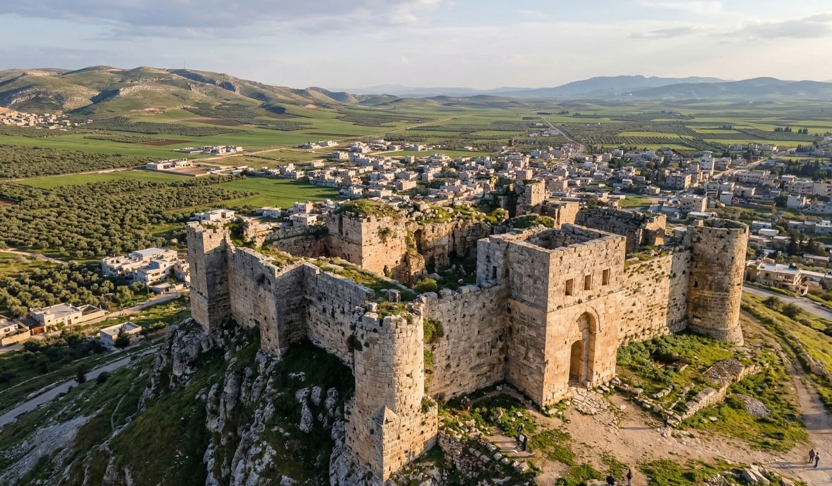
Harem Castle: A Historic Fortress in Northwestern Syria
Introduction to Harem Castle
Harem Castle is a historic fortress located in the Idlib countryside in northwestern Syria. A Castle stands on a strategic hill overlooking the surrounding plains and played an important role in the region’s military and defensive history.
Harem Castle stands on a high hill in northwestern Syria near the town of Harem. The castle overlooks key routes connecting Aleppo with Antakya.
For centuries, Harem Castle played a major military role thanks to its strategic location. Today, although much of the structure lies in ruins, the site remains a powerful symbol of Syria’s layered history.
Location of Harem Castle
Harem Castle rises above the fertile Amuq Plain, offering wide panoramic views of the surrounding countryside.
The castle is located about 55 km west of Aleppo, near the Syrian–Turkish border. This position made it a key defensive point controlling both trade and military movement across the region.
Early History of Harem Castle
Byzantine Origins
The first fortifications at Harem Castle date back to the Byzantine Empire in the 10th century.
The emperor Nikephoros II Phokas ordered the construction of the fortress around 959 AD to monitor and protect strategic routes.
Control by Regional Powers
After the Byzantine period, several powers controlled the castle, including:
Local Muslim forces
The Seljuk Empire
Crusader armies
Each ruling power reinforced the structure to defend against repeated attacks.
Crusader Period and Ayyubid Reconstruction
During the 11th and 12th centuries, Crusader forces occupied Harem Castle as part of their northern defense network.
In 1149, the Muslim ruler Nur ad-Din Zangi recaptured the fortress after major battles.
Later, the Ayyubid Dynasty strengthened and rebuilt the castle. The ruler Al-Malik al-Zahir Ghazi, son of Saladin, improved the fortifications and expanded the structure.
This period marked the peak of Harem Castle’s military strength.
Destruction of Harem Castle
The Mongol Invasion of Syria caused massive destruction across northern Syria.
In 1260, Mongol forces attacked the region and heavily damaged Harem Castle. Large sections collapsed, and the fortress gradually lost its strategic importance.
Later restoration attempts never fully restored its original scale.
Modern Damage and Earthquake Impact
The Syrian Civil War caused additional damage to Harem Castle.
Years of conflict weakened the already fragile ruins. Then, in 2023, the 2023 Turkey–Syria earthquake struck the region, further damaging the site.
Architectural Features of Harem Castle
Even in its ruined state, Harem Castle still reveals key architectural elements:
Elevated Defensive Position
The castle stands on a hill about 50 meters above the surrounding terrain, providing strong natural defense and visibility.
Moat and Underground Passages
Historical sources describe a surrounding moat and underground tunnels used for ventilation and escape.
Towers and Fortified Walls
The castle once featured multiple defensive towers and thick stone walls designed to resist sieges.
These features reflect centuries of military engineering across different empires.
Visiting Harem Castle Today
Current Conditions
Visiting Harem Castle today can be challenging due to the security situation in northwestern Syria. Access often depends on local conditions and coordination.
Travel Tips
Check current safety updates before visiting
Travel with an experienced local guide
Be prepared for limited infrastructure
How to Reach Harem Castle
Travelers can reach the castle by heading to the town of Harem in Idlib Governorate. From there, local roads lead up to the hilltop site.
Road conditions may vary, so careful planning is essential.
Why Harem Castle Matters
Harem Castle remains an important historical landmark in Syria.
First, it reflects centuries of conflict between major empires such as Byzantine, Crusader, and Islamic powers.
Second, it shows how geography influenced military strategy in the region.
Finally, the castle stands as a symbol of resilience despite war and natural disasters.
Today, Harem Castle continues to attract historians and visitors interested in Syria’s rich and complex past.
Leave a Reply