
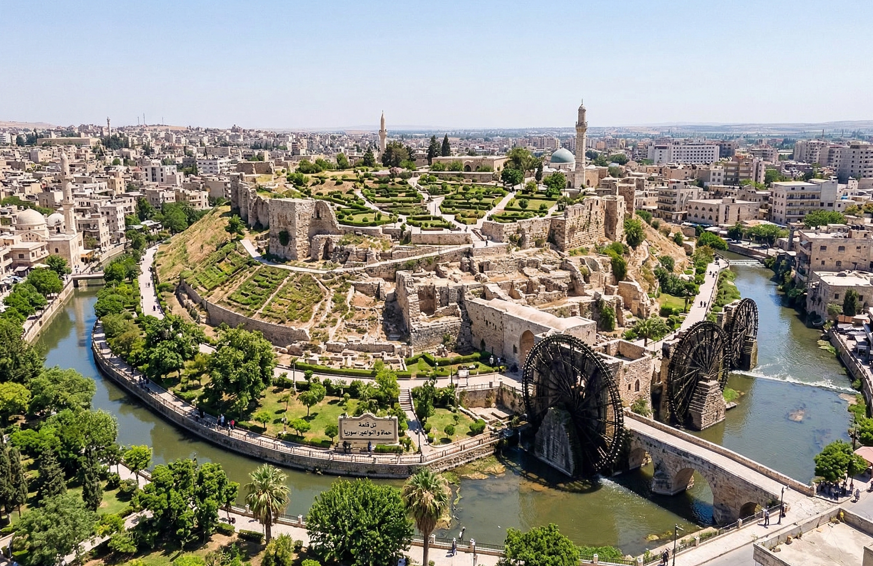
Hama Citadel (Hama): The Historic Stronghold Overlooking the Orontes River
Location and Strategic Importance of Hama Citadel
The Hama Citadel rises in the center of Hama, one of the oldest continuously inhabited cities in Syria. The fortress stands on a natural hill above the fertile valley of the Orontes River, a lifeline that has supported civilization for thousands of years.
Because of its elevated position, the Hama Citadel offers wide views across the city and surrounding plains. This vantage point allowed defenders to monitor movement along the river and nearby land routes.
Moreover, Hama has long served as a strategic link between major Syrian cities such as Aleppo and Damascus. As a result, controlling the citadel meant controlling key trade and military routes.
In addition, the Orontes River provided both natural protection and essential resources. Therefore, the citadel functioned not only as a defensive structure but also as part of a broader economic and urban system.
History of Hama Citadel
The Hama Citadel has roots that extend back to the Bronze Age. Archaeological evidence suggests that the hill was fortified by early civilizations due to its strategic location.
During the Hellenistic and Roman periods, Hama—then known as Epiphania—remained an important regional center. The citadel continued to serve defensive purposes during these eras.
Later, under Islamic rule, the city gained greater importance. The citadel was strengthened and developed as part of regional defense systems.
During the medieval period, the fortress played a role in conflicts involving Crusader forces and regional powers. Like many Syrian strongholds, it experienced cycles of destruction and rebuilding.
In the 12th century, the city came under the control of Saladin. During the Ayyubid period, the citadel likely underwent further expansion and reinforcement.
Under the Mamluks, Hama continued to serve as an administrative and military center. However, the role of the citadel gradually evolved as political conditions changed.
During the Ottoman era, the fortress lost much of its military significance. Advances in warfare and centralized governance reduced the need for such fortifications. As a result, the citadel slowly declined over time.
Architecture of Hama Citadel
The architecture of the Hama Citadel reflects multiple historical phases. Because the site was rebuilt over centuries, it combines elements from different periods.
The fortress features thick stone walls designed for durability and defense. These walls, along with the height of the hill, created a strong defensive system.
Unlike geometrically planned castles, the layout follows the natural contours of the terrain. This adaptation improved both structural strength and visibility.
The citadel likely included defensive towers placed at strategic points. These towers allowed guards to observe the surrounding area and respond quickly to potential threats.
Inside, the citadel may have contained administrative buildings, storage facilities, and residential quarters. Its role as both a military and administrative center made it more complex than smaller fortifications.
Water access was essential for survival. The proximity to the Orontes River ensured a steady supply, while internal storage systems may have supported the population during times of siege.
Today, much of the original structure has been lost. However, the remaining ruins and elevated mound still reflect the scale and importance of the citadel.
Why Hama Citadel Matters Today
The Hama Citadel represents a powerful symbol of the city’s long and continuous history. It reflects layers of civilization that have shaped the region over thousands of years.
Unlike isolated castles, the citadel was closely connected to daily urban life. It played a role in governance, defense, and economic activity.
In addition, the site highlights the historical importance of Hama within Syria. Its location along the Orontes River made it a key center for agriculture and trade.
Moreover, the citadel demonstrates how different civilizations reused and transformed the same strategic location. Each era contributed to its development and identity.
Today, preserving the Hama Citadel helps protect an essential part of cultural heritage. It also supports future tourism and historical awareness.
How to Visit Hama Citadel
Visitors can easily access the Hama Citadel within the city of Hama. Its central location makes it convenient to reach from various parts of the city.
Travelers coming from Homs or Damascus can use the main highway to reach Hama. From there, local transportation or walking routes lead to the citadel hill.
Exploring the site may involve walking on uneven surfaces. Therefore, comfortable footwear is recommended. Carrying water is also important, especially during warmer seasons.
Visitors can combine their trip with nearby attractions along the Orontes River. This allows for a richer cultural experience within the city.
However, it is important to check local conditions before planning a visit. Access may vary depending on circumstances. A local guide can enhance the experience by providing historical insights.
Conclusion
In conclusion, the Hama Citadel stands as a lasting symbol of resilience and historical continuity. From ancient times to the present, it has played a central role in the life of the city.
Because of its strategic position above the Orontes River, the citadel helped control movement and protect vital resources. Over time, it adapted to changing political and military conditions.
Although much of the original structure has disappeared, its historical significance remains strong. The site continues to reflect the importance of Hama in shaping regional history.
Today, the Hama Citadel offers visitors a unique opportunity to explore one of Syria’s oldest urban centers. It remains a valuable landmark that deserves recognition and preservation.
Leave a Reply