
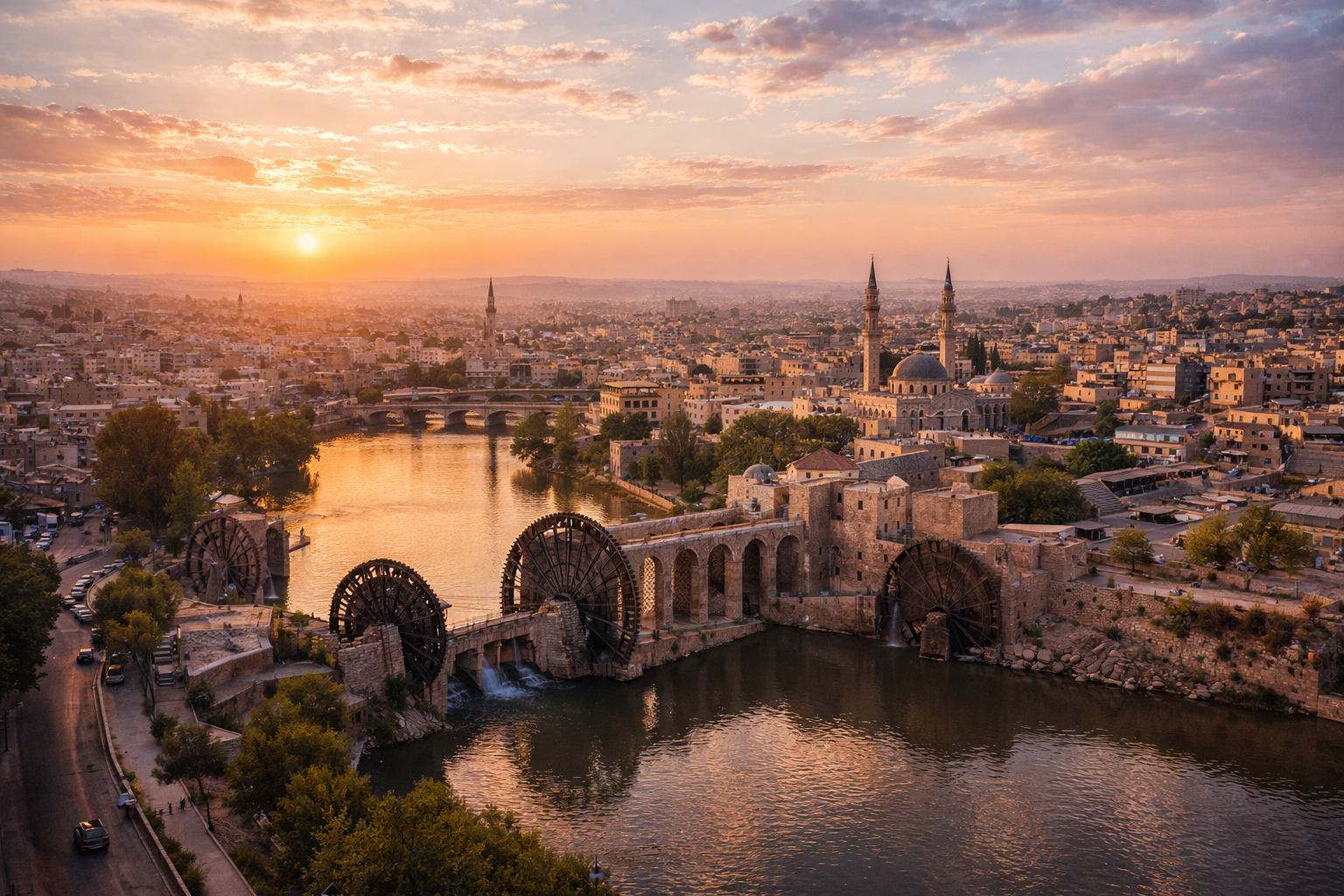
Hama is a historic city in central Syria, famous for its ancient water wheels (Norias) and rich cultural heritage.
Nestled in the fertile heart of Syria, Hama Governorate stands as one of the country’s most historically layered and culturally rich regions. Covering approximately 8,800 square kilometers in central Syria, Hama has long connected the northern plains with the southern heartlands. Shaped by the life-giving waters of the Orontes River (Al-Assi), the region preserves evidence of human settlement reaching back to the very dawn of civilization.
For thousands of years, geography, water, and strategic position combined to make Hama not only a place of survival, but a center of power, trade, and cultural exchange.
Geography and Strategic Location
Hama Governorate occupies a pivotal position within Syria’s central corridor, acting as a natural bridge between the Mediterranean hinterland to the west and the vast interior regions to the east. It borders Aleppo and Idlib to the north, Homs to the south, and stretches toward Raqqa and the Tartus–Latakia mountain ranges in the east and west.
At the heart of the region lies the Orontes River valley, whose fertile plains sustained agriculture and permanent settlement for millennia. The area enjoys a largely Mediterranean climate, with warm summers and mild, rain-fed winters. As a result, reliable water resources and arable land turned Hama into one of Syria’s most productive agricultural zones.
Because of this geography, City of Waterwheels repeatedly became a crossroads for ancient traders, migrating populations, and military campaigns, securing its role as a strategic linchpin throughout successive historical eras.
A Tapestry of Ancient Civilizations
Human habitation in Hama stretches back tens of thousands of years. Archaeological excavations reveal continuous settlement from the Middle Neolithic period (around 6500 BCE) through the Bronze and Iron Ages. Consequently, Hama plays a crucial role in understanding early urban development in the ancient Near East.
Hamath and the Syro-Hittite Period
By the early second millennium BCE, City of Waterwheels—then known as Hamath—emerged as the capital of a powerful Syro-Hittite kingdom. From here, local rulers influenced large portions of western Syria, forging alliances and waging conflicts that shaped the region long before the rise of classical empires.
Assyrians, Persians, and Greeks
Over the following centuries, regional dominance shifted repeatedly. The Assyrian Empire imposed tribute and military obligations, integrating Hamath into its imperial network. Later, the city entered the sphere of the Achaemenid Persian Empire. After Alexander the Great’s campaigns in the 4th century BCE, City of Waterwheelsbecame part of the Hellenistic world under the Seleucid dynasty, which renamed it Epiphaneia.
Roman and Byzantine Influence
Under Roman and Byzantine rule, Hama continued to thrive as a provincial urban center. Its location along major trade routes and its fertile hinterland ensured steady prosperity well into the early Christian period.
Power in the Middle Ages and the Cultural Integration of the City of Hama
The 7th century CE marked a decisive turning point with the arrival of Muslim Arab armies. During this period, a former Christian basilica was transformed into one of Syria’s earliest mosques, symbolizing the city’s integration into the Islamic world.
In the centuries that followed, City of Waterwheels experienced the turbulence of the Crusades, Ayyubid expansion, and Mamluk rule. Overlooking the Orontes River, Shayzar Castle became a focal point of these struggles, serving as both a defensive stronghold and an administrative center.
Throughout the medieval era, Hama’s diverse religious and cultural traditions enriched its architectural and intellectual life. At the same time, its strategic value ensured that rival powers continued to contest control over the region.
The Ottoman era, its architectural heritage, and its impact on the city of Hama
In the early 16th century, City of Waterwheels entered the Ottoman Empire, remaining under Ottoman administration for nearly four hundred years. This era introduced new administrative systems and left a lasting architectural imprint.
Among the most notable landmarks from this period is Qasr al-Azm (Azm Palace), an elegant 18th-century residence built for the Ottoman governor. Today, it serves as a museum displaying archaeological artifacts and offering insight into the region’s long history.
Ottoman rule also fostered vibrant civic and economic life. Crafts, textiles, and regional trade flourished, while the city’s iconic waterwheels (norias) along the Orontes became both functional infrastructure and enduring symbols of Hama’s ingenuity.
Engineering Marvels: The Norias of Hama
Few images represent City of Waterwheels more powerfully than its norias—massive wooden waterwheels, some exceeding 20 meters in diameter. Developed during the medieval period, these structures harnessed the current of the Orontes River to lift water into aqueducts, irrigating gardens, orchards, and urban spaces for centuries.
Beyond their practical role, the norias embody the city’s identity. Their rhythmic turning and distinctive creaking sound became inseparable from Hama’s daily life, making them among the most remarkable hydraulic achievements of the pre-modern world.

Twentieth-Century Transformations
Following World War I, City of Waterwheels fell under the French Mandate until Syrian independence in 1946. In the decades that followed, the governorate maintained its role as an agricultural powerhouse and regional market center.
Cotton, cereals, fruits, and textiles formed the backbone of the local economy, while fertile plains continued to sustain both urban and rural populations across central Syria.
The cultural and architectural heritage of the Syrian city of Hama before and after the war
Hama’s layered history remains visible in its enduring landmarks:
Hama Citadel and Castle Ruins – Traces of Hellenistic, Roman, and Islamic periods.
Great Mosque of Hama – A site that evolved from Roman origins to Byzantine church and later early Islamic mosque.
Shmemis Castle – A strategically significant fortress near Salamiyah.
Traditional Markets and Crafts – Living echoes of Hama’s long-standing commercial traditions.
Together, these sites reflect a landscape where Roman stonework, medieval fortresses, and Ottoman craftsmanship coexist.
The importance and identity of the city of Hama in the modern era
Today, Hama Governorate remains one of Syria’s most significant agricultural and demographic centers, with an estimated population of 1.5–1.8 million residents.
A video about the city of Hama is available on our YouTube channel.
Its strategic location continues to link northern and southern Syria, while agriculture and commerce remain central to its economic role. Although modern conflicts have affected infrastructure and demographics, City of Waterwheels’s enduring heritage—from ancient mounds to rotating norias—continues to attract historians, researchers, and visitors alike.
Daraa: History, Culture and Facts About Syria’s Southern City
Conclusion: A Living Chronicle of Syria
City of Waterwheels is far more than a geographical region; it is a living chronicle of human civilization. From Neolithic settlements and Syro-Hittite kingdoms to Roman roads, Ottoman palaces, and monumental norias, Hama’s story mirrors the broader history of the Near East.
Even today, its fields remain fertile, its monuments endure, and the Orontes River continues to turn its great wheels—reminding us that in Hama, the past and present flow together without separation.
Leave a Reply