
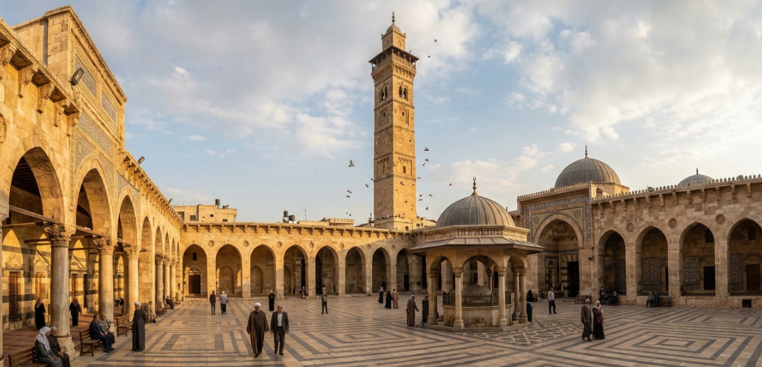
Great Mosque of Aleppo: A Historic Landmark in the Heart of Syria
Introduction to the Great Mosque of Aleppo
The Great Mosque of Aleppo is one of the most important religious and historical landmarks in Aleppo. Located in the historic Old City of Aleppo, the mosque has served as a spiritual and cultural center for more than a thousand years.
Throughout its long history, the Great Mosque of Aleppo witnessed major political, cultural, and architectural changes that shaped the city. Today, it remains a powerful symbol of Aleppo’s deep heritage and resilience.
History of the Great Mosque of Aleppo
Early Islamic Period
The Great Mosque of Aleppo dates back to the early Islamic period. The Umayyad Caliph al-Walid I ordered the construction of the mosque in the early 8th century, around 715 AD.
Builders created the mosque during a time when the Umayyad Caliphate expanded its influence across the Middle East. The design of the mosque reflected the architectural style of early Islamic religious buildings.
Medieval Expansion
Over the centuries, several rulers renovated and expanded the mosque. During the Seljuk Empire, craftsmen added the famous minaret in 1090 AD. This tall stone tower became one of the most recognizable landmarks in Aleppo.
Later, rulers from the Ayyubid Dynasty and the Mamluk Sultanate repaired and restored parts of the mosque after earthquakes and invasions.
Architectural Features of the Great Mosque of Aleppo
The Great Mosque of Aleppo displays several remarkable architectural elements.
The Historic Courtyard
The mosque contains a large open courtyard surrounded by elegant stone arcades. This courtyard allowed large numbers of worshippers to gather during prayers and religious events.
The Famous Minaret
For centuries, the mosque’s minaret stood as one of the most famous structures in Aleppo. Built in 1090, the square-shaped tower displayed intricate Islamic geometric decorations and carved inscriptions.
Prayer Hall
The main prayer hall features rows of columns supporting the roof. Inside the hall, visitors can see traditional Islamic architectural elements, including a mihrab indicating the direction of Mecca.
Destruction During the Syrian Civil War
The Syrian Civil War caused severe damage to many historic buildings in Aleppo.
In 2013, the famous minaret of the Great Mosque collapsed during intense fighting in the Old City. The destruction shocked historians, architects, and heritage organizations around the world.
Large parts of the mosque complex also suffered structural damage during battles between government forces and opposition groups.
Restoration and Reconstruction
After the conflict in Aleppo subsided, restoration teams began efforts to rebuild the Great Mosque.
Local authorities and heritage experts worked carefully to reconstruct damaged sections using traditional materials and historical records. The rebuilding of the minaret became one of the most symbolic restoration projects in the city.
These efforts aim to preserve the mosque as a cultural and religious landmark for future generations.
Location of the Great Mosque of Aleppo
The Great Mosque of Aleppo stands in the center of the historic Old City, near several important landmarks.
Nearby sites include:
Citadel of Aleppo
The historic covered markets of Aleppo
Traditional caravanserais and old streets of the medina
This location made the mosque an important gathering point for merchants, scholars, and residents throughout the city’s history.
Visiting the Great Mosque of Aleppo
Exploring the Old City
Visitors usually reach the Great Mosque while exploring the Old City of Aleppo. The mosque lies within walking distance of the citadel and the historic souks.
Cultural and Religious Importance
The mosque remains an important place of worship and a major historical attraction. Many visitors come to admire its architecture and learn about the deep history of Aleppo.
Why the Great Mosque of Aleppo Matters
The Great Mosque of Aleppo represents one of the most important historical monuments in Syria.
First, it reflects the architectural development of Islamic civilization across many centuries.
Second, it shows the historical importance of Aleppo as a center of culture and trade.
Finally, the mosque’s restoration demonstrates the determination to protect Syria’s cultural heritage despite years of conflict.
Today, the Great Mosque continues to stand as a powerful symbol of faith, history, and resilience in the heart of Aleppo.
Old Aleppo Markets Facts: The Largest Covered Souq in the World
Leave a Reply