
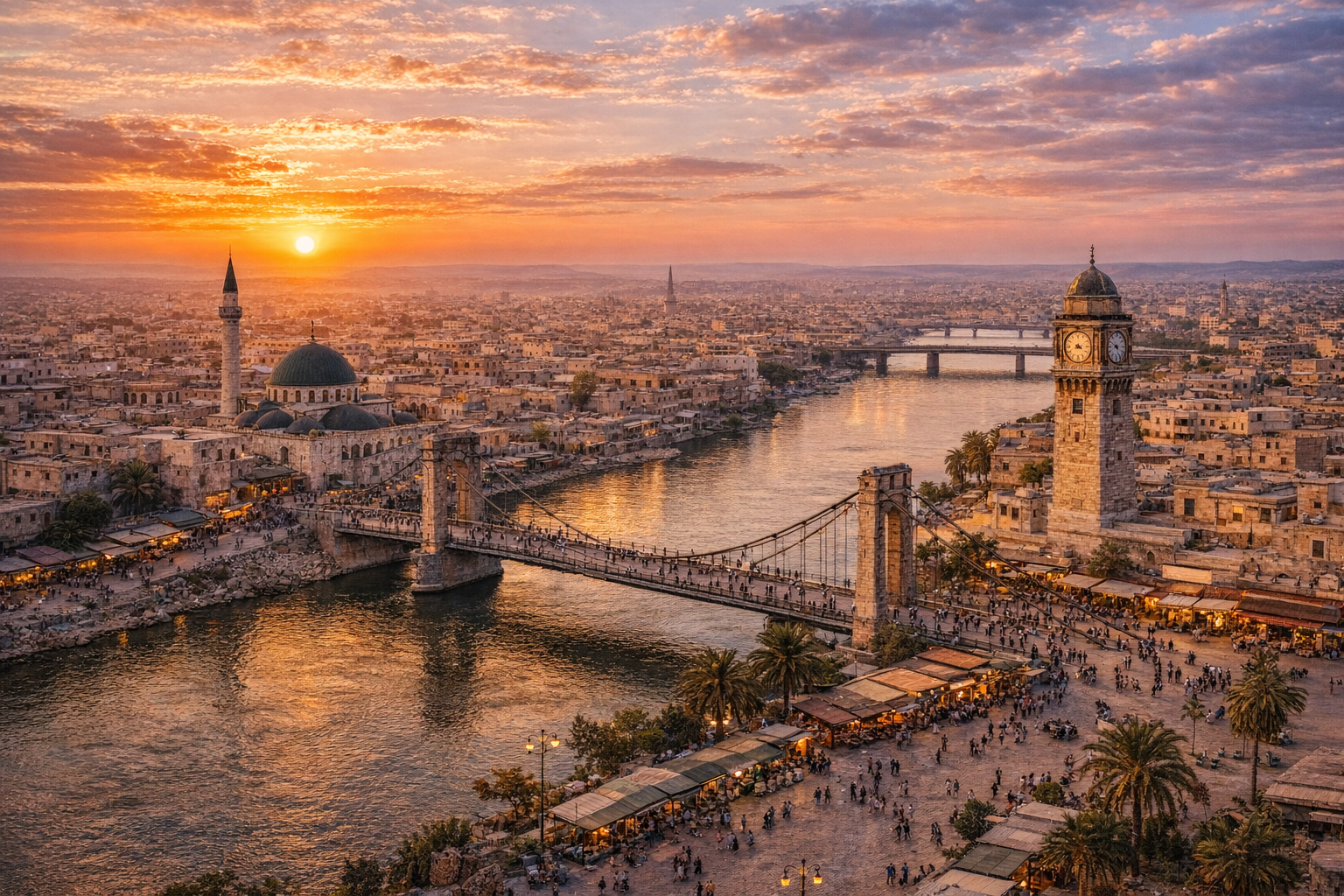
Deir ez-Zor is a city in eastern Syria located on the Euphrates River, known for its history, oil resources, and cultural heritage.
Deir ez-Zor Governorate is one of Syria’s most expansive and historically rich regions. It lies in the far east of the country along the life-giving Euphrates River. For millennia, it served as a bridge between the great civilizations of the Fertile Crescent. It also functioned as a vital agricultural heartland and a key node in trade routes. From ancient cities and empires to modern cultural achievements and strategic importance, Deir ez-Zor’s story reflects the broader tapestry of Middle Eastern history.
The geographical location of Deir ez-Zor: the heart of eastern Syria
Deir ez-Zor Governorate occupies a vast portion of eastern Syria. It stretches from the fertile floodplain of the Euphrates River into surrounding deserts. Its capital, also called Deir ez-Zor, sits about 450 km northeast of Damascus on the western bank of the Euphrates. The river bisects the landscape and provides essential water for cultivation. The region has an arid continental climate with hot, dry summers and cold winters.
This geographic position has long given the region strategic and economic importance. The Euphrates supports agriculture, including cereals, cotton, and livestock breeding. Historically, it connected Deir ez-Zor to trade routes linking Mesopotamia, the Levant, and beyond.
Ancient Roots: From Prehistory to Classical Empires
The lands of Deir ez-Zor have been inhabited since antiquity. In fact, human presence dates back to early Neolithic times. Archaeological surveys in the Euphrates valley reveal settlements and stone structures from before recorded history.
By the third millennium BCE, the region became part of some of the earliest complex states in human history. Akkadian and Assyrian realms exerted influence over Upper Mesopotamia and integrated Deir ez-Zor into imperial networks. Babylonians and Persians followed, and Macedonian forces arrived after Alexander the Great’s campaigns. Later, the Seleucid and Roman empires controlled the area. As a result, it served as a frontier district between competing powers and fostered cultural exchange and economic links.
World-renowned archaeological sites lie near present-day Deir ez-Zor, including Dura-Europos and the ancient city of Mari. These sites, therefore, provide rich evidence of the region’s role in trade, religion, and diplomacy.
Medieval to Ottoman Eras: Silk Roads and Sultanates
After Roman authority declined, Islamic caliphates and Turkic dynasties controlled the region. Eventually, the Ottoman Empire took over after 1517. Deir ez-Zor emerged as a modest but important town on the upper Euphrates. It served as an administrative center and trading post in the Ottoman provincial system.
Ottoman authorities fortified trade routes between Aleppo and Baghdad. Consequently, local populations engaged in agriculture, animal husbandry, and commerce. Despite Bedouin raids and political instability, the town maintained its strategic role as a link between desert interiors and coastal regions.

Modern History: Borders, Economies, and Cultural Identity of Deir ez-Zor
After the First World War and the collapse of Ottoman rule, British and Hashemite forces occupied the region. It later came under the French mandate as part of the Syrian state. In 1946, it became part of the independent Republic of Syria.
During the 20th century, Deir ez-Zor developed a mixed economy. Fertile lands produced wheat, barley, and cotton. Furthermore, oil discoveries in surrounding deserts transformed the governorate into an important energy region.
The city also became known for landmark infrastructure such as the suspension bridge across the Euphrates, built in the late 1920s during the French mandate. This bridge symbolized colonial investment and local pride.
Culturally, the region is home to Arab, Kurdish, Armenian, and Assyrian communities. In addition, Deir ez-Zor hosted universities, cultural centers, and the Deir ez-Zor Museum. The museum displays more than 25,000 archaeological objects from northeastern Syria, including artefacts from Mari and other ancient sites.
A Site of Memory: The Armenian Genocide Camps
One of the darkest chapters in Deir ez-Zor’s history occurred during the Armenian genocide of 1915–1916. Armenian refugees were forced on death marches into the Syrian desert and held in camps near Deir ez-Zor. Consequently, many died from starvation, disease, or execution.
The Armenian Genocide Martyrs’ Memorial Church was built in the city to commemorate these victims. It served as a museum, cultural space, and pilgrimage site until its destruction in 2014.
Economic and Strategic Importance
Deir ez-Zor Governorate holds major strategic economic resources. Agriculture supported Syria’s food systems for decades, especially cotton and grain farming. Oil and gas discoveries in the 20th century increased its importance in national energy strategies.
Its location on trans-desert routes made it a key logistical and commercial hub between Iraq and Syria. It links the Levant with the broader Middle East.
A video about the city of Deir ez-Zor is available on our YouTube channel.
Current context: Reconstruction and challenges in Deir ez-Zor
In recent years, the governorate experienced recovery efforts and ongoing hardships. Years of conflict damaged infrastructure, agriculture, and services. Housing, education, health, and utilities remain urgent needs.
Reconstruction projects aim to restore water stations, rebuild neighborhoods, and repair infrastructure. Many residents are returning after displacement. Authorities and communities are working to revive agriculture, repair roads, schools, and hospitals, and clear mines from fields and urban areas. These efforts aim to restore living standards and re-establish Deir ez-Zor as a productive governorate.
Aleppo: History, Culture and Facts About Syria’s Oldest Cities
Cultural heritage and future prospects of Deir ez-Zor
Deir ez-Zor’s cultural legacy endures in its museums, historical sites, and community memories. Its archaeological heritage continues to attract scholars. Furthermore, its agricultural and energy sectors hold strong potential for revitalization as stability returns.
Although history brought upheavals, Deir ez-Zor has shown resilience. The rhythms of the Euphrates and its role as a crossroads of civilizations continue to shape its future. Therefore, the region’s path forward is grounded in continuity, diversity, and reconstruction.
Daraa: History, Culture and Facts About Syria’s Southern City
Leave a Reply