
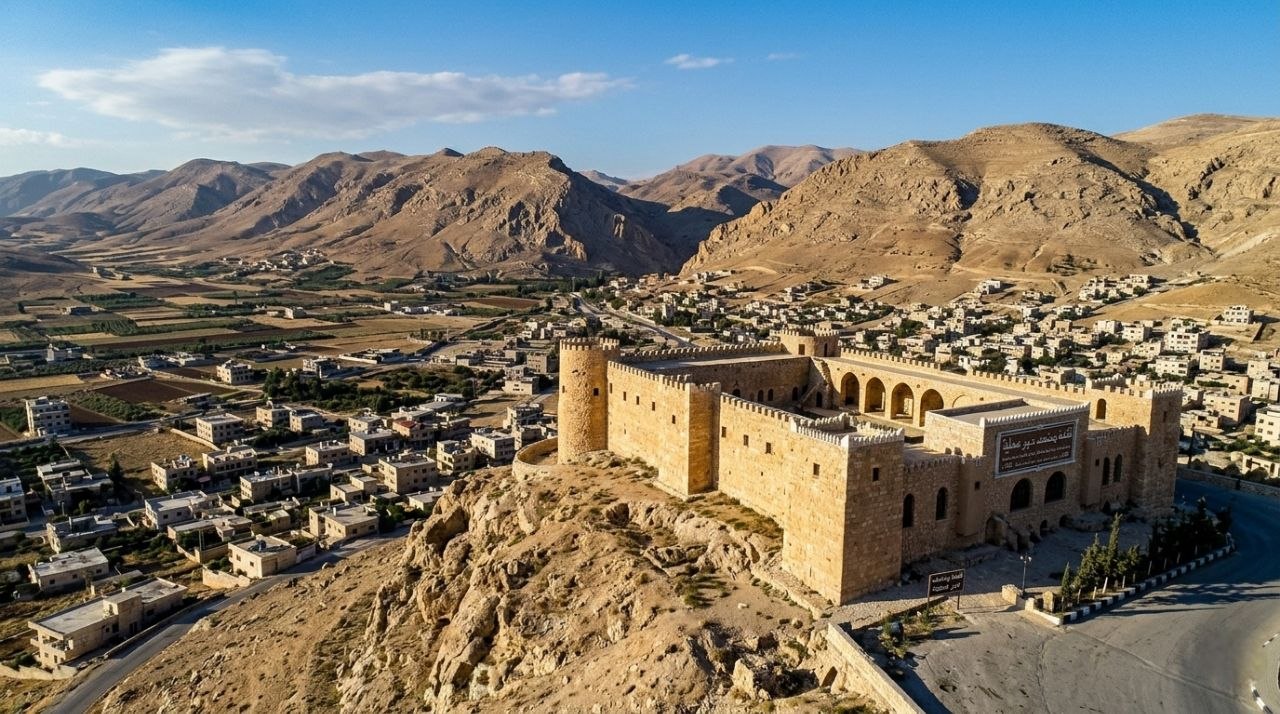
Deir Atiyah Castle (Qalamoun): A Forgotten Fortress of the Syrian Highlands
Location and Strategic Importance of Deir Atiyah Castle
Deir Atiyah Castle rises above the town of Deir Atiyah in the rugged Qalamoun Mountains. Because of its high position, the castle overlooks one of Syria’s most important historic corridors. This route links Damascus with northern cities such as Homs and Aleppo.
As a result, the site offered a strong strategic advantage. It allowed defenders to track movement across valleys and roads. In addition, the surrounding mountains created natural protection. Therefore, the castle worked as both a defensive post and an observation point.
Moreover, the Qalamoun region served as a gateway between central and northern Syria. Because of this, controlling the area meant controlling trade and military routes. Consequently, Deir Atiyah Castle became part of a wider network of mountain fortifications.
History of Deir Atiyah Castle
Deir Atiyah Castle dates back to the medieval period. Most historians link its construction to the 12th or 13th centuries. At that time, Syria experienced continuous political tension and military conflict. Different powers competed for control of major cities and routes.
Because of this instability, rulers built defensive structures across the mountains. Similarly, Deir Atiyah Castle supported nearby strongholds rather than acting as a major fortress. It helped monitor routes and provided early warning against approaching forces.
Furthermore, the castle likely played a role during conflicts between Islamic dynasties and Crusader forces. Although detailed records remain limited, its location clearly suggests a defensive purpose.
Later, during the Mamluk period, the importance of such mountain forts declined. Centralized military systems reduced the need for smaller outposts. In addition, new routes shifted traffic away from older paths.
As a result, the castle gradually lost its value. During the Ottoman era, it no longer served a military role. Consequently, it was abandoned and left to decay over time.
Architecture of Deir Atiyah Castle
The design of Deir Atiyah Castle reflects practicality and adaptation. Builders used local stone to create thick, durable walls. These materials blended with the surrounding landscape and increased strength.
In addition, the layout followed the natural shape of the hill. Instead of a strict geometric plan, the structure adapted to the terrain. This approach improved both stability and defense.
Moreover, It is likely that the castle had watchtowers at key locations.. These towers provided wide views of the valleys below. Because of this, guards could detect movement from long distances.
Inside, the structure remained simple. It included small rooms for soldiers, storage areas, and open spaces. Unlike major castles, it lacked decorative features. Instead, the design focused on function and survival.
Water storage also played an important role. Builders likely created cisterns to collect rainwater. This ensured a reliable supply during isolation or short sieges.
Today, only parts of the walls and foundations remain. However, these ruins still reveal the original layout. Visitors can understand how the fortress once operated within its environment.
Why Deir Atiyah Castle Matters Today
Deir Atiyah Castle represents an important but often overlooked part of Syrian heritage. While famous castles attract attention, smaller sites like this played key roles in regional defense.
Furthermore, the castle highlights the strategic value of the Qalamoun Mountains. This region connected major cities and supported trade networks. Because of this, it held great importance throughout history.
In addition, the site offers insight into medieval military planning. It shows how builders used geography as a defensive tool. Instead of relying only on large fortresses, they created networks of smaller observation نقاط.
Today, preserving such places helps protect a complete historical narrative. It also supports cultural awareness and future tourism.
How to Visit Deir Atiyah Castle
Visitors can reach Deir Atiyah Castle by traveling north from Damascus toward Deir Atiyah along the main highway. Once in the town, local roads lead toward the mountain area where the castle stands.
After that, the final part of the journey may require walking. The terrain can be uneven, so comfortable shoes are essential. In addition, carrying water is recommended due to the elevation.
However, visitors should always check local conditions before traveling. Access may vary depending on the situation. Therefore, local guides can provide valuable support and context.
Conclusion
In conclusion, Deir Atiyah Castle stands as a quiet witness to Syria’s layered past. Although it lacks the scale of major fortresses, it played a vital role in protecting key routes.
Because of its location, the castle helped control movement and support regional defense. Over time, it lost its importance and became a ruin. However, its remains still tell a powerful story.
Today, the site offers a unique opportunity to explore a lesser-known chapter of Syrian history. It reflects resilience, adaptation, and the lasting importance of geography in shaping human events.
Leave a Reply