
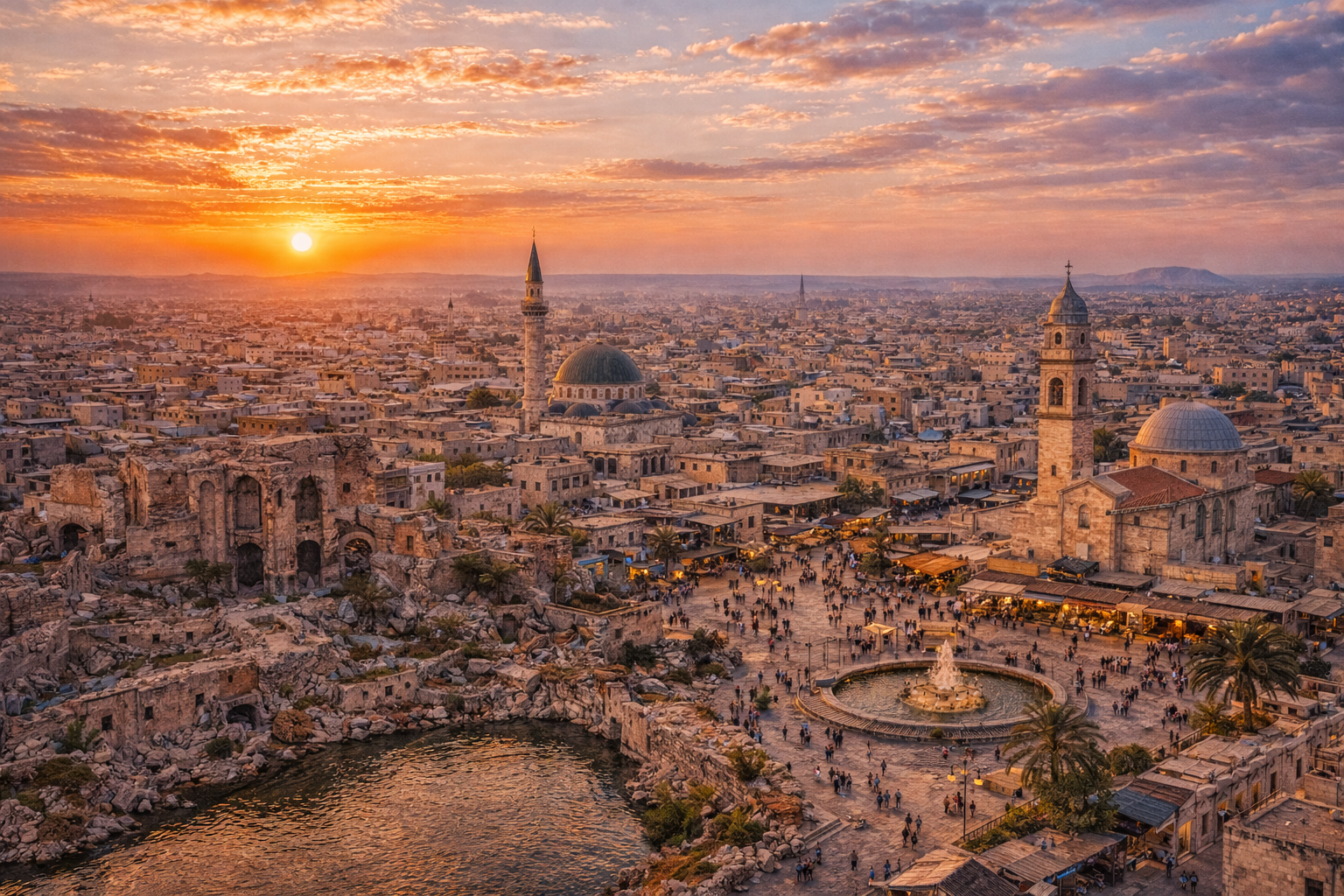
Daraa Governorate: Crossroads of Civilizations, Conflict, and Resilience
Daraa Governorate in southern Syria is a land marked by ancient heritage, strategic geography, and turbulent modern history. Throughout history, this region has stood at the crossroads of empires and modern borders. Consequently, Daraa has been a cradle of civilizations, a battleground of wars, and, more recently, the birthplace of one of the most consequential uprisings of the 21st century. This article explores its location, history, cultural importance, and evolving role in the past and present.
Geographical Setting and Strategic Importance
Daraa Governorate is located in the extreme southwest of Syria, forming a gateway between the Levant and the Arabian Peninsula. Moreover, it shares an international border with the Hashemite Kingdom of Jordan to the south, while Syrian governorates such as Quneitra lie to the west, Rif Dimashq to the north, and As-Suwayda to the east. Covering roughly 3,700–4,650 square kilometers, the region forms part of the larger Hauran plain, which is a fertile agricultural landscape that has supported human settlement for millennia.
Its capital is the city of Daraa, which is situated just a few kilometers from the Jordanian frontier. Historically and presently, this city has been a vital transportation and communication junction linking Damascus, Amman, and other Middle Eastern cities. As a result, its economic and strategic significance has remained high for centuries.
Ancient Roots: Civilizations and Cultural Heritage of Daraa
Long before modern borders existed, Daraa was at the heart of ancient Syria. Archaeological evidence reveals human presence in the region as early as the Neolithic period (approximately 6000–4000 BCE). Furthermore, excavations around the city of Daraa have uncovered remnants of ancient dwellings. These findings suggest continuous habitation for thousands of years.
Daraa and its surrounding areas have witnessed the flow of multiple civilizations, including:
Canaanites and Amorites: Early Semitic groups who dominated the region before the rise of major empires.
Aramaic and Iron Age cultures: These cultures flourished across southern Syria and left significant linguistic and cultural imprints.
Idlib Facts: Syria’s Olive City Explained
Roman and Byzantine Empires: Cities like Bosra (Busra al-Sham), a UNESCO-listed archaeological site, exhibit exceptionally well-preserved Roman theatres, colonnaded streets, and basilicas. Therefore, they reflect the grandeur of classical antiquity.
Early Islamic era: During this period, the region remained an administrative and strategic center under successive Islamic caliphates, integrating new cultural and architectural influences.
In addition, important archaeological sites abound in the governorate. Izraa’s ancient churches and Roman remains, the Hauran basalt landscapes with dolmens and rock-cut tombs, and numerous mosaics dating back to the 5th–6th centuries CE all testify to a layered and diverse historical legacy.

Daraa Through the Ages: Empires and Battles
Thanks to its borderland position, Daraa was frequently affected by conquest and conflict. For example, in 636 CE, the Battle of Yarmouk near the governorate marked a decisive Arab victory over Byzantine forces. This victory opened Syria to Islamic rule.
Later, during World War I, the region again became a theater of conflict as Ottoman forces clashed with advancing British and Arab armies. Because of its strategic roads and proximity to borders, Daraa played an important role in military strategy and logistics.
In the 20th century, the region experienced changing colonial and post-colonial politics. After the French Mandate period, Daraa became part of the modern Syrian state. Nevertheless, it remained a primarily agricultural region, known especially for wheat, barley, olives, and diverse crops. It supported both local and national food supplies.
Modern History: The Cradle of the Syrian Uprising
The 21st century brought seismic changes to Daraa that reverberated across Syria and the broader Middle East. In March 2011, inspired by the wave of protests across the Arab world known as the Arab Spring, a group of teenagers in Daraa was detained for writing anti-government graffiti. Subsequently, the authorities’ harsh response ignited public demonstrations that rapidly spread nationwide.
Soon afterward, Daraa became known as the “cradle of the revolution,” with its protests marking the beginning of what evolved into the Syrian Civil War. This conflict would later become one of the longest and most devastating of the early 21st century.
Over the following years, the governorate witnessed repeated offensives and battles between government forces, opposition groups, and extremist factions. Moreover, multiple military campaigns, including the Southwestern Daraa offensives and the broader Daraa Governorate campaign, saw towns and countryside change hands repeatedly. Consequently, substantial destruction and civilian suffering occurred.
A video about the city of Daraa is available on our YouTube channel.
By 2020, government forces had reasserted significant control. However, unrest persisted in many areas. In December 2024, Hayʾat Tahrir al-Sham, a dominant rebel faction, reportedly seized control of Daraa, which underscored continued instability.
In early 2025, the region again drew international attention when the Syrian government condemned Israeli air strikes on Daraa. These strikes reportedly caused civilian casualties and further complicated the security environment.
Human Impact: War, Displacement, and Migration
The prolonged conflict has had profound human consequences. Beyond battlefield destruction, thousands of residents have been displaced both internally and abroad. Additionally, migration pressures have grown due to economic hardship, drought, insecurity, and compulsory military service. As a result, many people—especially youth—have undertaken dangerous journeys across land and sea toward Europe and other destinations.
This exodus has significantly altered the social fabric of the governorate. Meanwhile, diaspora communities continue to maintain cultural traditions and networks outside Syria.
Cultural Resilience and Heritage Preservation
Despite extensive war damage, Daraa’s cultural identity endures. Local efforts—often informal—seek to document traditions, preserve memories, and protect what remains of architectural heritage. Moreover, generations of craftspeople, storytellers, and community leaders strive to keep alive the social and cultural tapestry that has given Daraa its distinct character.
However, many ancient monuments and historic sites suffered damage or neglect during the war years. Therefore, restoration remains a formidable challenge for the future.
In conclusion: Daraa is a region with a glorious past and present challenges.
Daraa Governorate stands as a compelling example of how geography, history, and human aspiration intersect. From its ancient beginnings as part of early civilizations, through its role in Islamic conquests and world wars, to its central place in contemporary Syrian history, Daraa’s story is one of resilience amidst adversity.
Today, its fertile lands continue to support agriculture, its cities echo with layers of cultural memory, and its people persist in seeking stability and prosperity in a region still marked by uncertainty. Ultimately, as Syria and the world look toward the future, Daraa remains a testament to the enduring interplay of place, history, and human experience.
.
Deir ez-Zor: History, Culture and Facts About Syria’s Euphrates City
Leave a Reply