
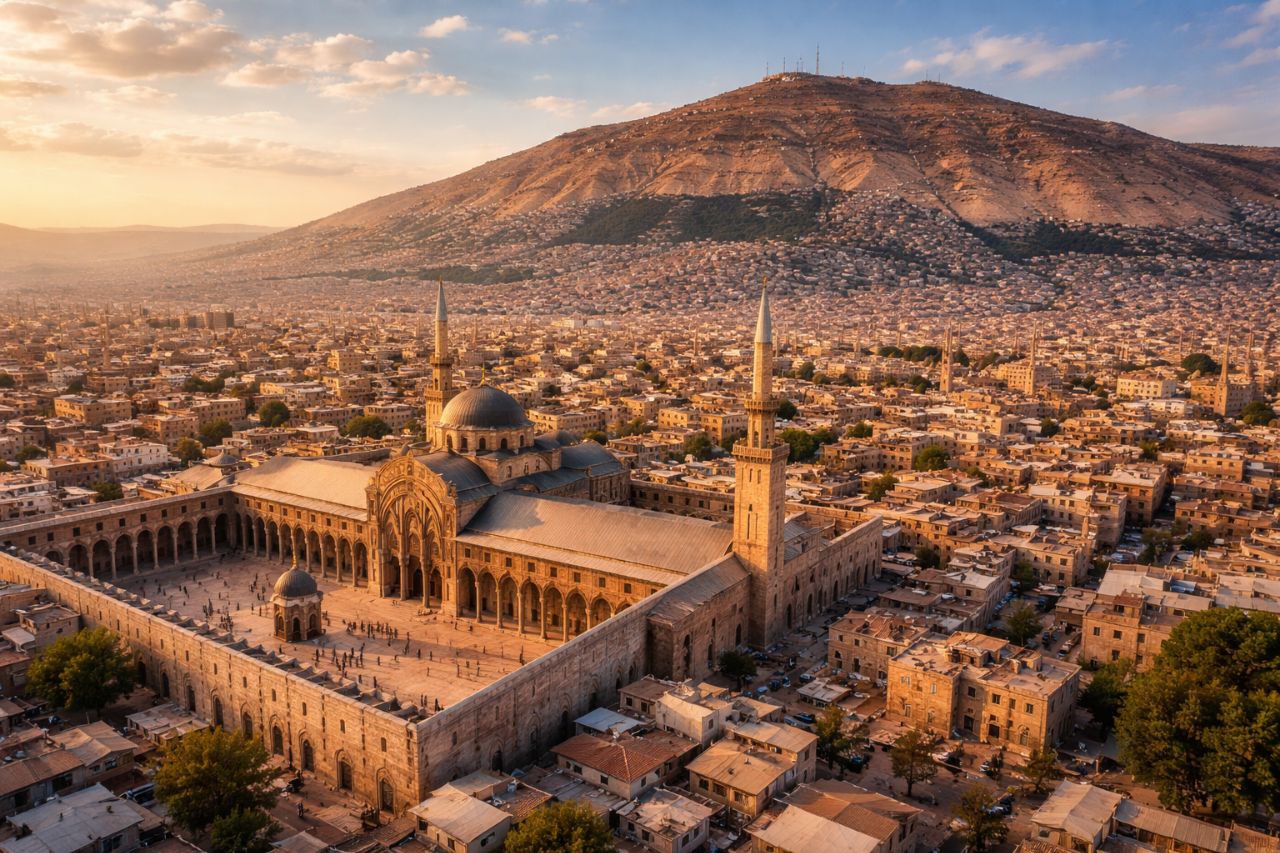
Damascus is the capital city of Syria and one of the oldest continuously inhabited cities in the world.
Damascus, often known as “al-Fayḥāʾ” — “the Fragrant One,” ranks among the oldest continuously inhabited cities on Earth. For thousands of years, civilizations have walked its streets, built its monuments, and shaped its identity. Today, history still lives in its alleys, markets, mosques, and homes.
Where East Meets West: The Geographic Heart
Geographically, syria capital city lies in southwestern Syria, resting on a fertile oasis fed by the Barada River, just south of Mount Qasioun and at the edge of the Syrian Desert. Because of this location, the city naturally connected the Mediterranean coast with Mesopotamia and the Arabian Peninsula.
As a result, traders, armies, scholars, and pilgrims passed through Damascus for centuries. Meanwhile, the surrounding oasis, historically known as al-Ghūṭah, provided water and fertile land. This rare combination allowed Damascus to thrive while many other settlements faded.
Born of Antiquity: Early Civilizations and Growth
Archaeological evidence suggests human settlement in the Syrian capital area as early as 8,000–10,000 BCE. However, the city rose to prominence under the Aramaeans, who made it their capital in the early first millennium BCE.
Over time, several great empires ruled Damascus:
Assyrians in the 8th century BCE
Babylonians in the 7th century BCE
Persians in the 6th century BCE
Greeks under Alexander the Great in 333 BCE
Romans in the 1st century BCE
Under Roman rule, Damascus became a major trade center. Furthermore, Roman planning and architecture shaped much of the Old City’s layout, traces of which remain visible today.
The Islamic Golden Age and Umayyad Splendor of Damascus
In the 7th century CE, the Muslim conquest transformed Damascus’s destiny. Soon after, in 661 CE, Muʿāwiyah ibn Abi Sufyan established the Umayyad Caliphate with Damascus as its capital.
During this period, the city stood at the center of an empire stretching from Spain to Central Asia. Most notably, builders completed the Umayyad Mosque between 706 and 715 CE. Built atop earlier Roman and Byzantine structures, the mosque reflects Damascus’s layered spiritual and cultural history.

Battleground of Empires: Crusades, Mongols, and Ottomans
After the Umayyads, power shifted between the Abbasids, Seljuks, and later the Mamluks. During the Crusades, Damascus served as a key defensive stronghold. Leaders such as Saladin and Baybars played vital roles in protecting the region.
Later, in the 16th century, Syrian capital entered the Ottoman Empire. For four centuries, it functioned as an important administrative, economic, and pilgrimage center within Ottoman Syria.
Damascus Modern History: Mandate and Independence
Following World War I, Ottoman rule ended. Briefly, Syrian capital became the capital of the Arab Kingdom of Syria in 1920. However, French forces soon imposed the French Mandate, which lasted until Syrian independence in 1946.
After independence, Syrian capital emerged as the political heart of the Syrian Republic. Over the decades, it witnessed political shifts, social change, and regional conflicts.
Damascus in the 21st Century: Conflict and Continuity
Since 2011, the Syrian conflict has deeply affected the country. Nevertheless, Syrian capital remained a symbol of political continuity for much of this period. At the same time, economic hardship, regional tensions, and displacement reshaped daily life.
Even so, the city continues to function, adapt, and endure.
The cultural significance of Damascus: a living museum
Today, Syrian capital feels like a living museum. Its Old City, a UNESCO World Heritage Site, contains hundreds of historical landmarks. Among them are Roman remains, medieval mosques, Ottoman houses, and vibrant souks.
A video related to the city of Damascus on our YouTube channel.
Moreover, artisans still practice crafts passed down for generations. Languages, customs, and architecture blend seamlessly, reflecting centuries of cultural exchange.
Aleppo: History, Culture and Facts About Syria’s Oldest Cities
The Spirit of Damascus: Past, Present, and Future
Ultimately, Damascus’s greatness lies not only in its age, but in its resilience. Empires rose and fell, yet the city endured. From Aramaean kings to Umayyad scholars and modern residents, each generation left its mark.
In conclusion, Syrian capital stands as a city where history never sleeps — a place where the past and present meet at every corner, and where human civilization continues its long, unbroken story.
Qasr al-Banat in Raqqa: History and Facts About the Ancient Palace
Leave a Reply