
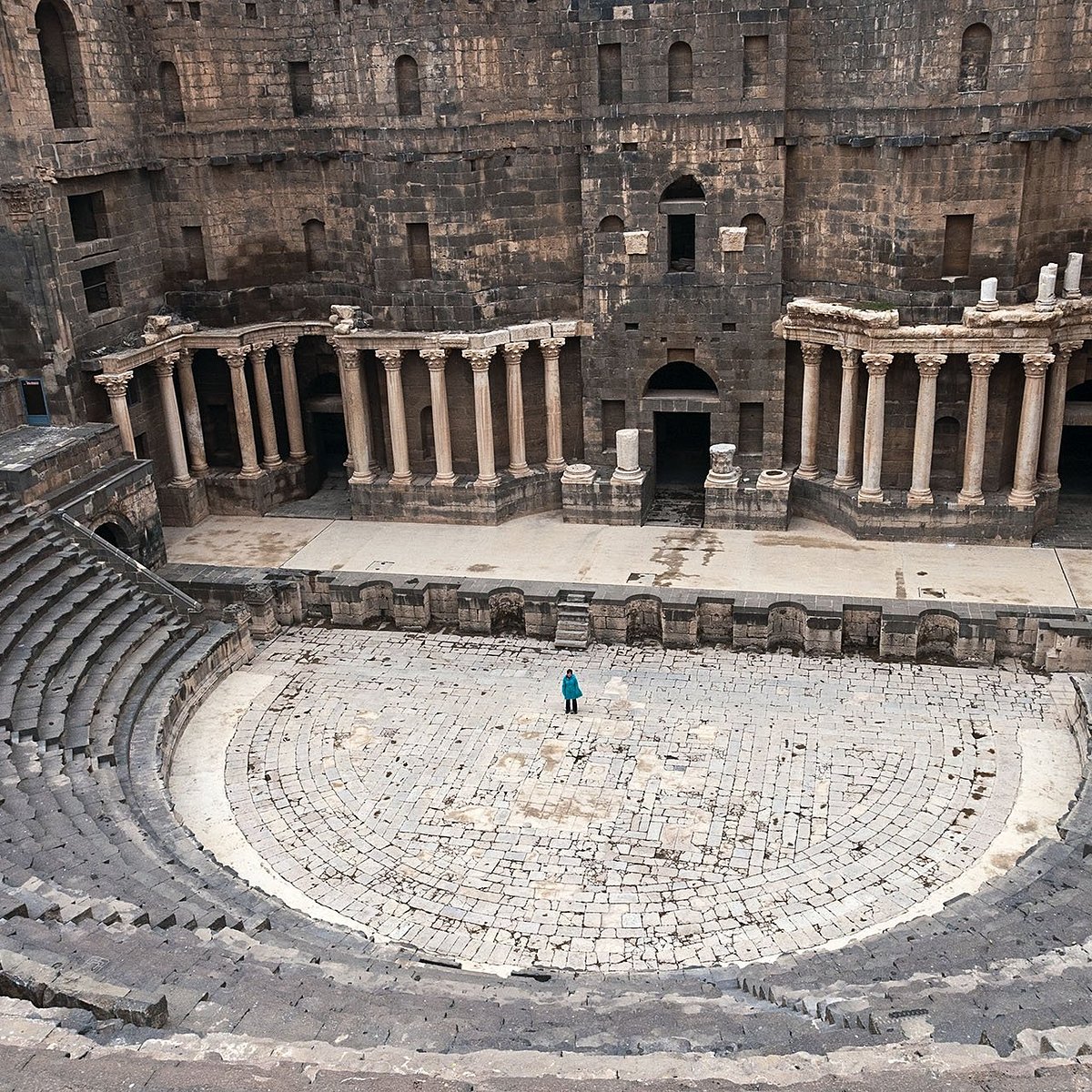
Bosra al-Sham: A Living Chronicle of Civilizations in Southern Syria
Bosra al-Sham is one of the most extraordinary archaeological cities in the Middle East and a rare example of a place where multiple layers of history remain visibly intertwined. Located in southern Syria, this ancient city stands as a living chronicle of civilizations that flourished over thousands of years. From Nabataean traders and Roman emperors to Byzantine bishops and Islamic dynasties, Bosra al-Sham has played a vital role in political, religious, and cultural history. Today, Bosra al-Sham recognized as a UNESCO World Heritage Site and a powerful symbol of Syria’s enduring heritage.
Geographical Location of Bosra al-Sham
Bosra al-Sham lies in southern Syria within the Daraa Governorate, about 140 kilometers south of Damascus and close to the Jordanian border. Moreover, the city sits in the fertile Hauran Plain, a region historically famous for agriculture and trade.
This location placed the city at the crossroads of ancient caravan networks linking Arabia, the Levant, and the Mediterranean, transforming it into a long-standing center of commerce, culture, and administration.
Origins and Early History of Bosra al-Sham
The earliest evidence of settlement in the area dates back to the second millennium BCE. While the city already held regional importance, its major rise began under the Nabataean Kingdom in the 1st century BCE.
In 106 CE, the Roman Empire annexed the Nabataean realm, turning Bosra into the capital of the province of Arabia Petraea. This event marked the beginning of its golden age, during which monumental Roman architecture reshaped the city into one of the region’s most impressive urban centers.

Bosra al-Sham During the Roman Era
Under Roman administration, the city flourished politically, economically, and architecturally. Urban development included:
Paved streets and colonnades
Public baths and temples
Fortifications and administrative complexes
Most importantly, Roman builders constructed the Roman Theatre of Bosra in the 2nd century CE, likely during Emperor Trajan’s reign. They used black basalt stone and designed the theatre to hold nearly 15,000 spectators. As a result, it remains one of the largest and best-preserved Roman theatres in the world.
Byzantine Bosra and Christian Heritage
Following the division of the Roman Empire, the city came under Byzantine rule. Christianity spread rapidly, and Bosra emerged as a significant religious center, housing early Christian communities and serving as a bishopric.
Churches were integrated into the Roman urban layout, reflecting the transition from pagan traditions to Christian culture. Many of these structures remain visible today, embedded within later architectural layers.
Bosra al-Sham in Islamic History
In the 7th century CE, the city became one of the first in Syria to enter Islamic rule. It holds special importance in Islamic tradition due to its association with the encounter between the young Prophet Muhammad (peace be upon him) and the monk Bahira.
Under successive Islamic dynasties — Umayyads, Abbasids, Ayyubids, and Mamluks — the city remained active and strategically important. Roman and Byzantine structures were adapted rather than destroyed, with churches converted into mosques and the Roman theatre transformed into a fortified citadel.
Architectural Significance of Bosra al-Sham
What makes Bosra al-Sham unique is the coexistence of multiple historical layers in one compact urban space. Visitors encounter:
Roman theatres and streets
Byzantine churches
Early Islamic mosques
Medieval fortifications
The widespread use of locally sourced black basalt stone gives the city a distinctive architectural identity unmatched by other Roman cities.
Historical Importance of Bosra al-Sham
Historically, the city’s significance stemmed from:
Its role as the capital of Roman Arabia Petraea
It is position as a key trade hub on caravan routes
Its religious importance for Christianity and early Islam
Its strength as a medieval military stronghold
Therefore, trade, agriculture, and geography directly shaped its long-term prosperity.
Bosra al-Sham in the Modern Era
Today, Bosra al-Sham appears smaller than it did in antiquity. Nevertheless, its historical value remains immense.
Designated a UNESCO World Heritage Site in 1980, it continues to attract global attention for its cultural significance.
Although recent conflicts caused damage, many monuments still stand. Moreover, preservation efforts continue, ensuring that the city remains a visible link to Syria’s ancient past.
Tourism and Visiting Bosra al-Sham Today
Most archaeological landmarks are concentrated within walking distance, making exploration easy. The Roman Theatre-Citadel remains the main attraction, complemented by ancient streets, mosques, and scattered ruins throughout the old city.
Spring and autumn are the best seasons to visit due to mild weather.
How to Reach Bosra al-Sham
From Damascus: Around 2.5–3 hours by car via the Damascus–Daraa highway
From Daraa: Approximately 40 kilometers east
Local Transport: Taxis and local buses operate from nearby towns
Once visitors arrive, they can easily reach most sites by walking.
Entrance Fees for Bosra al-Sham (2026)
There is currently no universally fixed entrance fee for the entire archaeological area. Many sections remain freely accessible, while certain monuments — particularly the Roman Theatre-Citadel — may require a small local fee depending on regulations.
A video about Busra al-Sham is on our YouTube channel.
Therefore, visitors in 2026 should check local regulations before entering major sites.
Shayzar Castle (Chizar): History and Facts About the Ancient Fortress in Hama
Conclusion: Why Bosra al-Sham Matters
Bosra al-Sham represents far more than an archaeological site. Instead, it functions as a living museum where history unfolds across centuries. Few cities worldwide display such a seamless blend of Nabataean, Roman, Byzantine, and Islamic heritage.
For historians, travelers, and cultural enthusiasts, Bosra al-Sham stands as a timeless testament to human resilience, adaptation, and creativity — and a cornerstone of Syria’s civilizational legacy.
Leave a Reply