
🏛️ Bab al-Jabiyah: The Western Gateway of Damascus Through the Ages
Introduction to Bab al-Jabiyah
In the heart of Damascus — one of the world’s oldest continuously inhabited cities — stand the remnants of ancient gates that once defined the city’s defensive and social life. Among them, Bab al-Jabiyah remains one of the most historically significant. Positioned on the western side of the Old City walls, Bab al-Jabiyah has served for centuries as a threshold for traders, armies, pilgrims, and everyday citizens entering Damascus from the Mediterranean and inland routes.
More than a simple gateway, Bab al-Jabiyah reflects the transformation of Damascus from a Roman provincial capital to a center of Islamic civilization and, eventually, to the vibrant urban landscape seen today.
📜 The Meaning and Origins of Bab al-Jabiyah
Bab al-Jabiyah (Arabic: باب الجابية) takes its name from Jabiyah, an ancient settlement in the Golan region that once served as the capital of the Ghassanids, Arab allies of the Roman Empire. The name became widely used during the Umayyad period, embedding the gate within early Islamic history.
During the Roman era, however, the gate carried a different identity. It was dedicated to Mars, the Roman god of war, and functioned as the principal western entrance to the city. Bab al-Jabiyah marked the western end of the Decumanus Maximus — the great east–west axis of Roman Damascus — known historically as the Street Called Straight. This grand avenue connected Bab al-Jabiyah directly to Bab Sharqi, the Eastern Gate.
🏗️ Roman Architecture of Bab al-Jabiyah
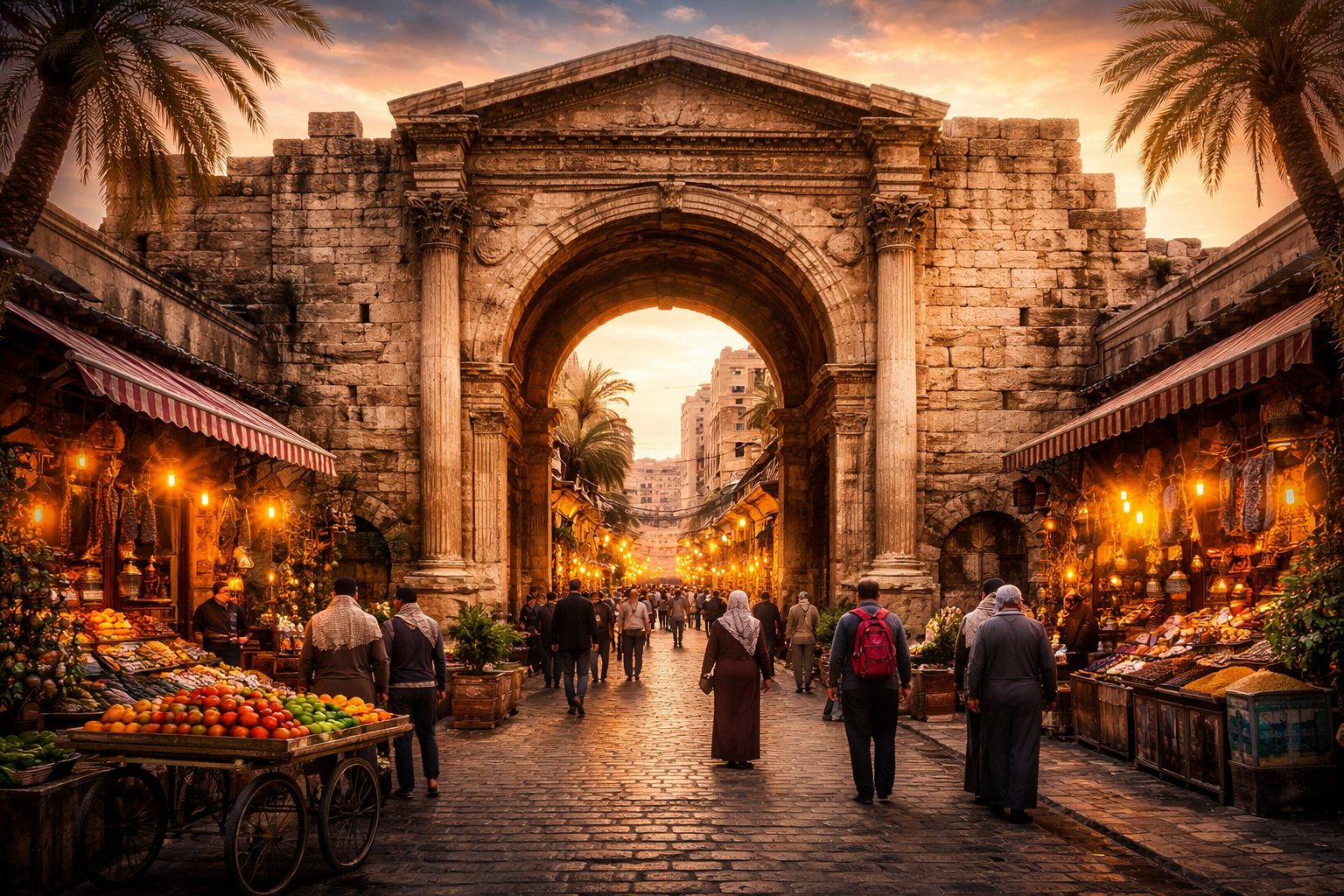
In its original Roman form, Bab al-Jabiyah featured a tripartite design:
A large central arch for carts and caravans
Two smaller side entrances for pedestrians
This layout aligned with the Roman urban grid, emphasizing symmetry and civic grandeur. The gate stood not merely as a defensive structure but as a ceremonial entrance into a thriving provincial metropolis.
Nearby landmarks during Roman times included the Temple of Jupiter and other major civic buildings, highlighting the gate’s role as an entry point into one of the most important cities of the Roman East.
⚔️ Bab al-Jabiyah and the Islamic Conquest of Damascus
Bab al-Jabiyah occupies a pivotal place in early Islamic history. During the Rashidun conquest of Damascus in 634 CE, Muslim forces negotiated the city’s surrender. Historical accounts state that the general Abu Ubaidah ibn al-Jarrah entered peacefully through Bab al-Jabiyah, while Khalid ibn al-Walid entered from the eastern side of the city.
This event marked the transition of Damascus from Byzantine control to Islamic rule, profoundly reshaping the city’s political and cultural trajectory.
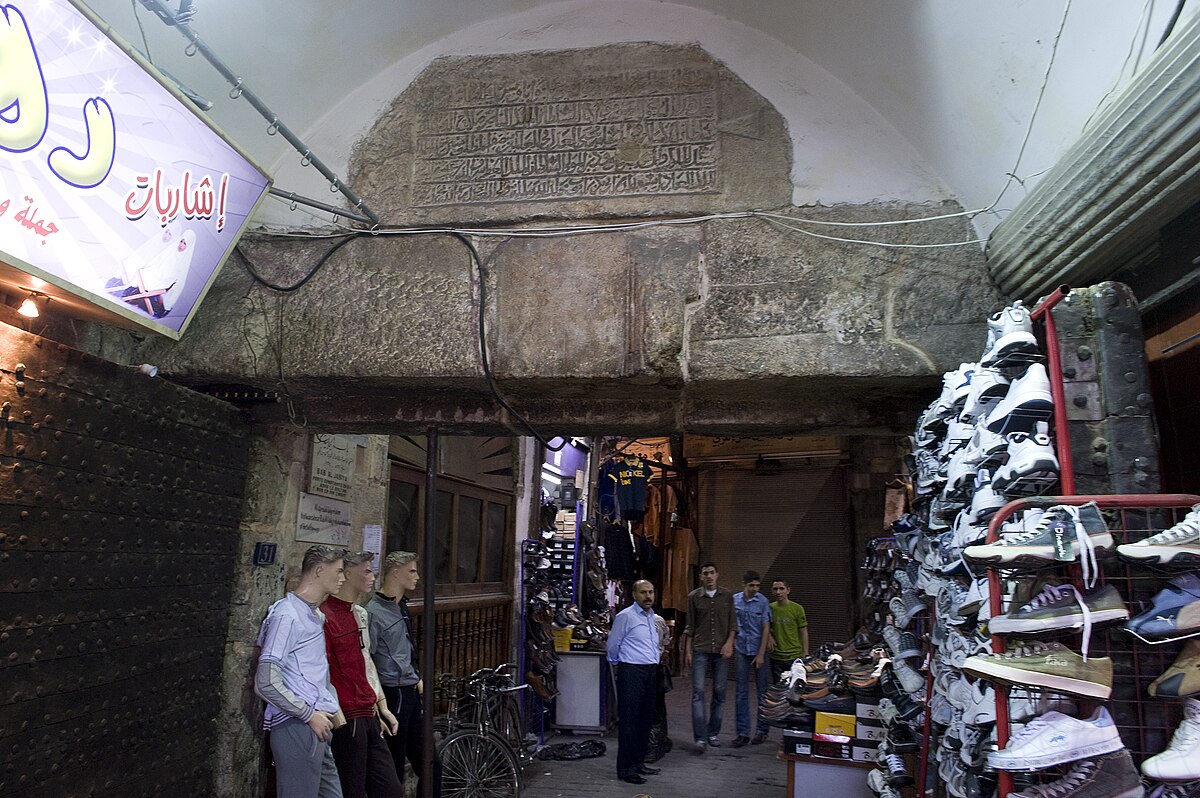
Following the conquest, modifications were made to Bab al-Jabiyah. Much of its original Roman width was reduced, leaving a smaller, more controlled entrance — a form that largely persists today.
🏰 Medieval Reconstruction of Bab al-Jabiyah
Over the centuries, Bab al-Jabiyah underwent several restorations and structural reinforcements.
Notable renovations occurred under:
Nur ad-Din in the 12th century, with inscriptions dating to around 1164 CE
Ayyubid and Mamluk rulers, who strengthened the gate to meet evolving defensive requirements
These medieval interventions altered the Roman grandeur of Bab al-Jabiyeh while preserving its essential function as a western portal into Damascus.
🌍 Bab al-Jabiyah: Then and Now
Then — Gateway of Empires
In antiquity and the medieval era, Bab al-Jabiyeh served as the primary entry point for caravans arriving from western Syria and the Mediterranean coast. Merchants carrying goods, pilgrims traveling to sacred sites, and diplomatic envoys all passed beneath its arches.
The gate acted as a conduit of commerce and culture, linking Damascus to regional and international trade networks.
Now — A Living Urban Quarter
Today, Bab al-Jabiyah opens onto Midhat Pasha Street — the western stretch of the ancient Straight Street. This bustling market area continues to pulse with life, filled with shops, vendors, and traditional Damascene architecture.
The area remains embedded within the living fabric of Old Damascus. Visitors encounter historic mosques, traditional houses, and vibrant commercial activity. The proximity to landmarks such as the Umayyad Mosque further enhances its importance within the city’s historic core.
📍 Location and How to Reach Bab al-Jabiyeh
Bab al-Jabiyah stands on the western edge of the Old City of Damascus. Unlike isolated monuments, it is integrated into the surrounding urban environment.
How to Get There
On Foot: Walking through the Old City offers the most immersive experience. Bab al-Jabiyeh connects naturally to historic markets and streets.
Public Transport: Local buses and taxis can drop visitors near the Old City perimeter, from where the gate is a short walk.
Historic Route: Following Midhat Pasha Street eastward leads directly toward the city’s interior landmarks.
Exploring Bab al-Jabiyeh provides insight into the layered history of Damascus — from Roman planning to Islamic governance and modern daily life.
Bab Touma Damascus: Historic Gate and Christian Quarter Guide
🕰️ Final Thoughts on Bab al-Jabiyah
Bab al-Jabiyah stands as a living monument rather than a silent relic. Its stones have witnessed Roman legions, Byzantine administrators, Islamic generals, medieval merchants, and contemporary residents passing through its narrow entrance.
As a western gateway, Bab al-Jabiyeh symbolizes both arrival and transition. It bridges empires and eras, reflecting the resilience and continuity of Damascus itself.
Walking beneath its arch today offers more than historical appreciation — it invites visitors to step into a story that has unfolded for nearly two thousand years and continues to evolve with every passing generation.
Bab Sharqi Damascus: The Historic Eastern Gate of Old Damascus
We would be delighted if you could view the Bab al-Jabiyeh video on our YouTube channel.
Leave a Reply