
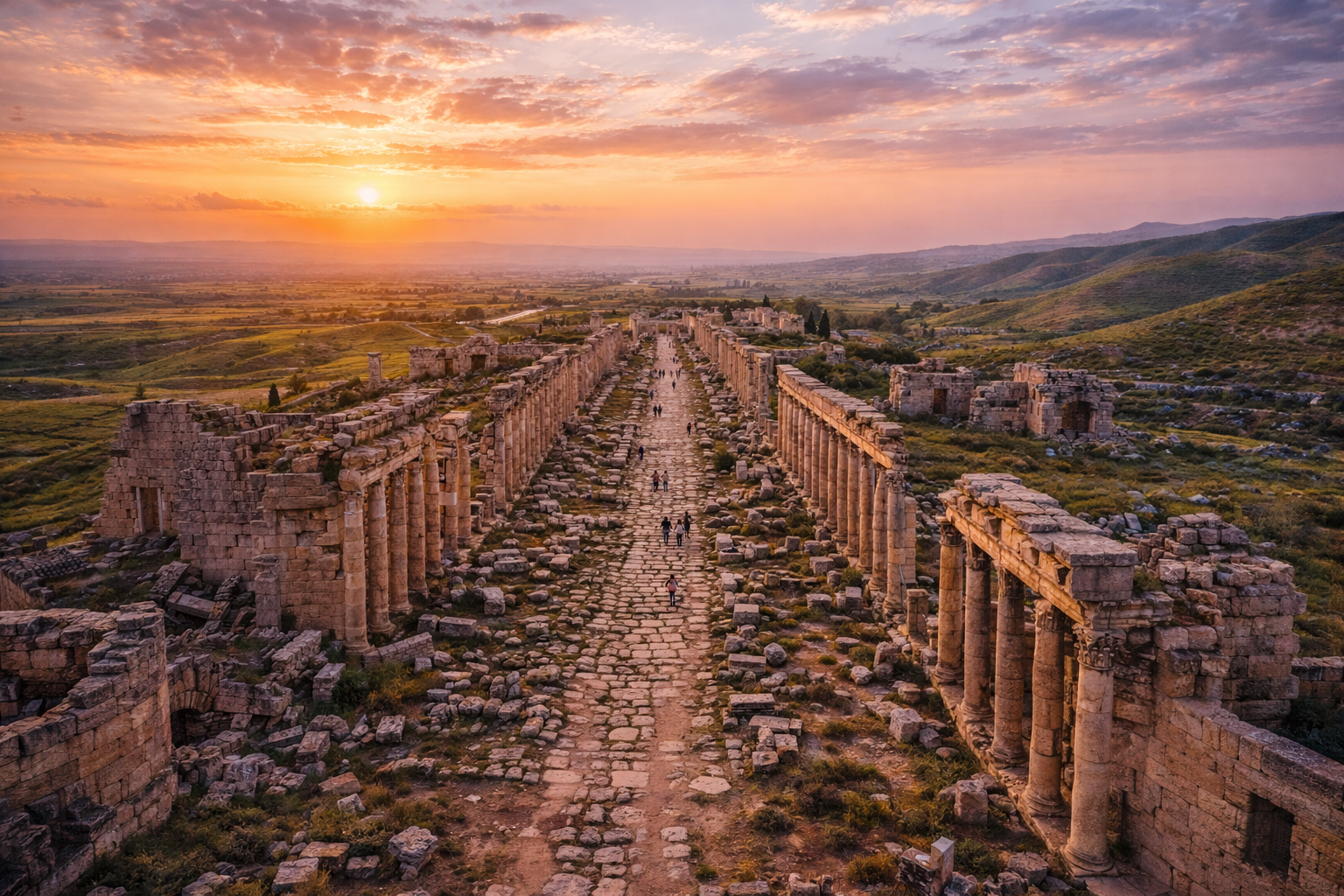
Apamea, also known as Afamia, is an ancient city in the Hama countryside in Syria, famous for its Roman ruins and one of the longest colonnaded streets in the ancient world.
Nestled in the fertile plains of western Syria, where the waters of the Orontes River wind past fields and rolling hills, lie the evocative remnants of Apamea — once a powerful city of empires, now a breathtaking archaeological site. Known in Arabic as Afamia or Qalaat al-Madiq today, Apamea stands as a testament to centuries of human civilization, cultural fusion, and historical upheaval.
Where History Meets the Horizon
Afamia, is located in the Hama Governorate of Syria, situated about 55 kilometers (34 miles) northwest of the city of Hama, overlooking the broad Ghab Plain — a fertile agricultural area shaped by the Orontes River’s ancient floodwaters.
This stretch of countryside, rich with soil and stories alike, was historically strategic — a crossroads linking inland Syria with Mediterranean trade routes and a coveted prize for empires through the ages.
Apamea: From the splendor of the Seleucids to the grandeur of the Romans
The documented story of Apamea begins around 300 BCE, when Seleucus I Nicator — a general under Alexander the Great and later ruler of the vast Seleucid Empire — rebuilt and expanded the settlement. He named it Apamea in honor of his Persian wife, Apama, following his victory at the Battle of Ipsus.
Under Seleucid rule, the city became one of the Syrian Tetrapolis — a group of four principal cities designed to administer and Hellenize the region. Apamea’s spacious streets, monumental architecture, and commanding position above the Orontes made it a significant administrative and military center.
In 64 BCE, the Roman general Pompey the Great incorporated Apamea into the Roman province of Syria. Roman rule brought vast construction projects, public buildings, and a remarkable city layout reflecting classical urban design.
Awe-Inspiring Ruins: What Remains Today
Although centuries of earthquakes, wars, and time have reduced Apamea to ruins, its scale and engineering brilliance remain staggering.
🏛️ The Great Colonnade
The defining feature of Apamea is its Great Colonnade — a monumental colonnaded avenue that once stretched for nearly 2 kilometers (1.2 miles), forming the city’s main north-south axis (the cardo maximus). Lined with towering limestone columns, it was one of the longest colonnaded streets of the ancient world.
Today, hundreds of columns, some restored and many still standing, trace out the grand path that once guided chariots, merchants, philosophers, and citizens through the heart of the city.
🎭 Roman Theatre
Apamea also boasted one of the largest Roman theatres in the empire, with an impressive seating capacity that may have exceeded 20,000 spectators in its prime. Though much of the structure lies in ruins, its scale still hints at the cultural vibrancy of ancient performances and gatherings.
🏺 Other Remains
Scattered across the site are foundations of temples, baths, houses, and civic buildings — each stone whispering fragments of daily life from Hellenistic banquets to Roman civic rituals.

Apamea through the ages and empires
Apamea’s long history reflects the tumultuous history of the Levant:
- 🌿 Under the Seleucids, it flourished as a planned Hellenistic city built with philosophical and architectural ambition.
- 🛡️ During the Roman era, it became a vibrant provincial hub with grand civic spaces.
- ✝️ In the Byzantine period, it served as a religious and administrative center.
- 🕌 Through the Islamic centuries, including early Caliphates and later dynasties, the region’s cultural and political landscape shifted again and again.
- 🌍 By the 13th century, repeated earthquakes and changing geopolitical tides led to the city’s decline and eventual abandonment.
Across these ages, Apamea witnessed layers of civilization that still speak through its broken columns.
Modern Significance and Conservation
Today, Apamea is not just an archaeological treasure—it’s a symbol of Syria’s rich cultural heritage and the endurance of human creativity. The nearby village of Qalaat al-Madiq now occupies part of the ancient site’s footprint, where locals and visitors alike can explore fragments of the past.
Efforts to protect and document what remains continue despite the challenges posed by regional instability. Preservation work and renewed interest from researchers and travelers alike underscore the global value of this site.
How to Reach Apamea
Traveling responsibly and securely is essential when visiting historical sites in Syria. Here’s how you can reach Apamea:
🚗 By Car or Private Transport
- From Hama — Apamea is roughly 55 km northwest and can be reached by car or taxi in about 45–60 minutes via well-maintained roads.
- From Damascus — The journey takes approximately 2.5 hours by car, combining highway travel and local roads toward the Orontes valley.
🚌 Public Transport
Public buses may operate to nearby towns, but direct access to the archaeological site usually requires private hire or organized tours.
🚶 On Foot Once There
The site is best explored on foot — ancient stones, colonnaded streets, and subtle terrain changes make walking both the most rewarding and practical way to experience Apamea’s ruins. Comfortable shoes are a must!
Also watch a video about Apamea on our YouTube channel.
Visiting Tips
- 🌤️ Best Seasons: Spring and autumn typically offer pleasant weather for exploring the site without extreme heat.
- 📸 Bring Water and Sun Protection: The countryside setting means limited services on site.
- 🗺️ Combine Nearby Sites: Pair your visit with Qalaat al-Madiq castle for panoramic views over the Orontes valley and ruins.
Margat Castle (Al-Marqab): History and Facts About Syria’s Crusader Fortress
Why Apamea Still Matters
Afamia, isn’t merely a collection of stone and dust. It stands as a layered archive of human history — a city that rose by empire, lived through times of peace and conflict, and now endures as a silent storyteller of our shared past. For historians, travelers, and curious minds alike, Apamea offers a rare chance to walk among columns that once echoed with the footsteps of empires.
Whether imagined in its prime or felt in its present stillness, Apamea remains a poignant reminder of the civilizations that shaped the ancient world and the landscapes they inhabited.
Leave a Reply