
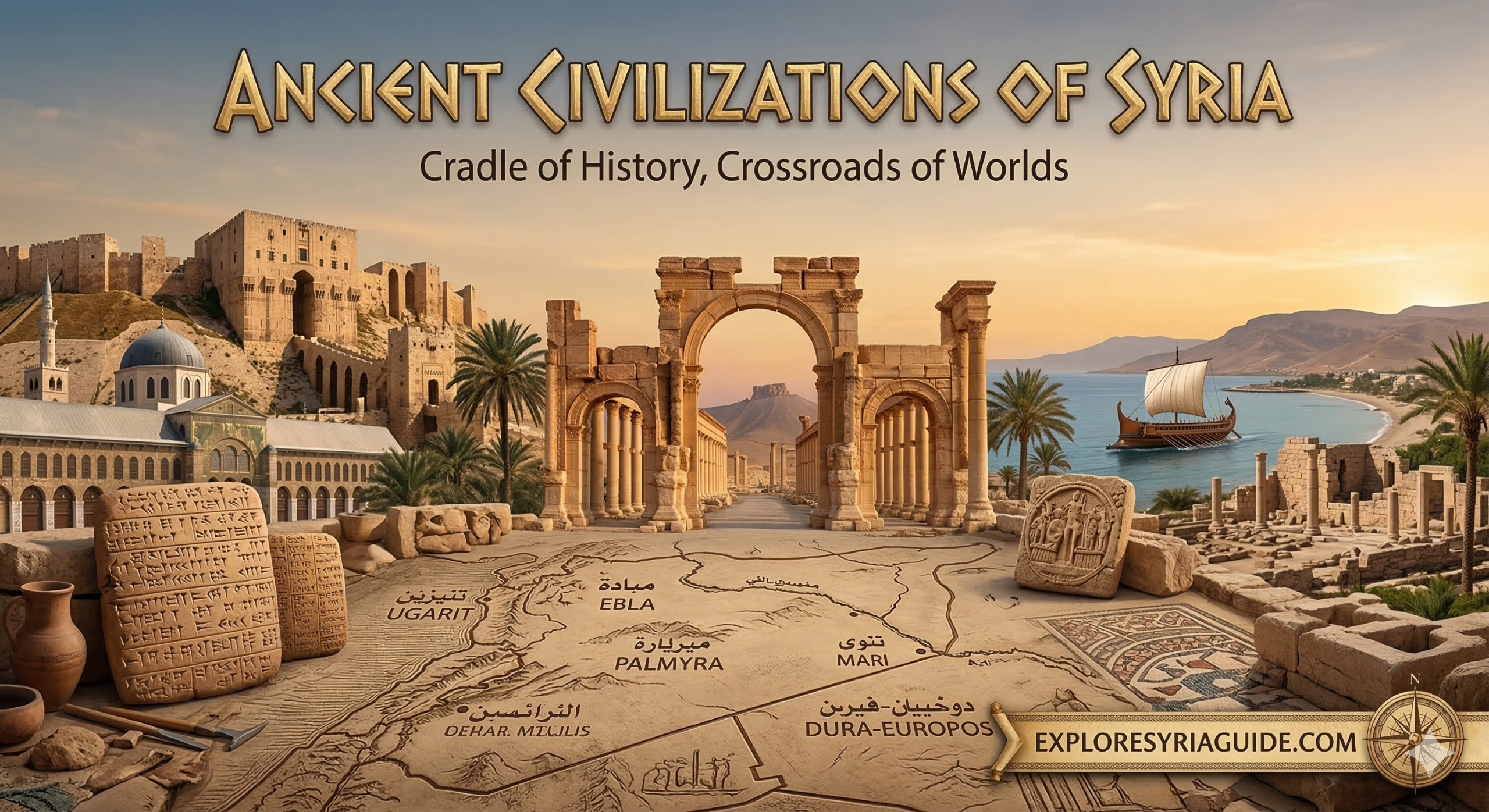
Ancient Civilizations of Syria: A Journey Through 10,000 Years of History
Syria is considered one of the most historically rich regions in the world. Located in the heart of the Fertile Crescent, the land of Syria witnessed the rise and fall of many great civilizations that shaped human history.
From prehistoric settlements and early farming communities to powerful empires and Islamic dynasties, the territory of modern Syria has been a crossroads of cultures, trade, and innovation for thousands of years.( Ancient Civilizations of Syria ).
Archaeological discoveries across the country reveal evidence of some of the oldest cities, writing systems, and civilizations in human history.( Ancient Civilizations of Syria )
Prehistoric Civilization (Stone Age)
Long before the rise of organized states, early human communities settled in northern and eastern Syria.
Important prehistoric archaeological sites include:( Ancient Civilizations of Syria )
Tell Mureybet – Raqqa
Tell Halaf – Al-Hasakah
Tell Brak – Al-Hasakah
Tell Leilan – Al-Hasakah
Tell Ashara – Deir ez-Zor
These settlements show early evidence of agriculture, animal domestication, and village life.
Sumerian Civilization
During the early Bronze Age, parts of northern Syria were influenced by the Sumerian culture of Mesopotamia.
Key archaeological sites include:
Tell Brak – Al-Hasakah
Tell Leilan – Al-Hasakah
These sites show evidence of early urban development and trade networks.
Akkadian Civilization
The Akkadian Empire expanded into northern Syria during the third millennium BCE.
Important sites connected to Akkadian influence include:
Tell Brak – Al-Hasakah
Tell Leilan – Al-Hasakah
Tell Beydar – Raqqa
These cities played an important role in trade and administration.
Amorite Civilization ( Ancient Civilizations of Syria )
The Amorites established powerful kingdoms across Syria during the second millennium BCE.
Major Amorite cities include:
Mari (Tell Hariri) – Deir ez-Zor
Ebla (Tell Mardikh) – Idlib
Ebla in particular became one of the most important ancient cities in the Near East, famous for its large archive of clay tablets.
Canaanite and Phoenician Civilization
The coastal regions of Syria were home to the Canaanite and Phoenician civilizations, which were famous for trade and maritime culture.
Important sites include:
Ugarit (Ras Shamra) – Latakia
Amrit – Tartus
Arwad – Tartus
Ancient Jableh – Latakia
Ugarit is especially famous for the Ugaritic alphabet, one of the earliest known alphabetic writing systems.
Aramean Civilization ( Ancient Civilizations of Syria )
The Arameans established several kingdoms in Syria during the first millennium BCE.
Important Aramean centers include:
Damascus (Ancient Damascus)
Ancient Hama – Hama
Tell Halaf – Al-Hasakah
Tell Hama – Hama
Aramaic later became one of the most widely used languages in the Near East.
Assyrian Civilization ( Ancient Civilizations of Syria )
The Assyrian Empire controlled large parts of Syria during the Iron Age.
Key archaeological sites include:
Tell Halaf – Al-Hasakah
Tell Ashara – Deir ez-Zor
Tell Sheikh Hamad – Deir ez-Zor
These sites contain important remains of Assyrian administration and architecture.
Hittite Civilization ( Ancient Civilizations of Syria )
The Hittites were another powerful Bronze Age civilization that influenced northern Syria.
Important sites include:
Ain Dara – Aleppo countryside
Tell Arfad – Aleppo countryside
Jarabulus – Aleppo countryside
These locations contain temples, sculptures, and ancient fortifications.
Persian Civilization
The Persian Achaemenid Empire ruled Syria during the 6th and 5th centuries BCE.
Important centers during this period included:
Damascus
Bosra – Daraa
Greek (Hellenistic) Civilization
After the conquests of Alexander the Great, Syria became part of the Hellenistic world.
Important cities include:
Apamea – Hama
Palmyra – Homs
Seleucia Pieria – Latakia
Roman Civilization
The Roman Empire left some of the most impressive archaeological remains in Syria.
Major Roman cities include:
Palmyra – Homs
Bosra – Daraa
Apamea – Hama
Shahba – As-Suwayda
Resafa – Raqqa
Dura-Europos – Deir ez-Zor
Byzantine Civilization
During the Byzantine period, many Christian cities and churches were built across Syria.
Important sites include:
Dead Cities – Idlib
Qal’at Sim’an – Aleppo countryside
Resafa – Raqqa
Harim Castle – Idlib
Umayyad Islamic Civilization
The Umayyad Caliphate made Damascus the capital of the Islamic world.
Important monuments include:
Umayyad Mosque – Damascus
Old City of Damascus
Qasr al-Hayr al-Sharqi – Homs
Qasr al-Hayr al-Gharbi – Homs
Abbasid Civilization
The Abbasid period brought important developments to eastern Syria.
Important locations include:
Raqqa
Qasr al-Banat – Raqqa
Raqqa City Walls
Ayyubid Civilization
The Ayyubid dynasty strengthened many fortifications across Syria.
Important castles include:
Citadel of Damascus
Citadel of Hama
Mamluk Civilization
The Mamluks developed trade centers and markets.
Important historical sites include:
Khan Al-Assal – Aleppo
Khan Al-Harir – Aleppo
Khan Al-Shouneh – Aleppo
Al‑Takiyya Al‑Suleimaniyya – Damascus
Crusader Period
During the medieval period, Crusader castles were built in western Syria.
Famous examples include:
Krak des Chevaliers – Homs
Margat Castle – Tartus
Safita Tower – Tartus
Ottoman Civilization
Syria became part of the Ottoman Empire for several centuries.
Important sites include:
Al‑Hamidiyah Souq – Damascus
Al-Takiyya Al-Suleimaniyya – Damascus
Khan As’ad Pasha – Damascus
Aleppo Saray – Aleppo
Modern Era
During the late Ottoman and early modern period, new infrastructure projects were built.
Important landmarks include:
Hejaz Railway – Damascus
Hejaz Railway Station – Damascus
Why Syria Is Called the Cradle of Civilizations
Syria is often described as one of the cradles of human civilization because it has witnessed thousands of years of continuous cultural development.
From prehistoric villages to powerful empires and Islamic capitals, the country preserves an extraordinary historical legacy that reflects the diversity of human history.
Leave a Reply