
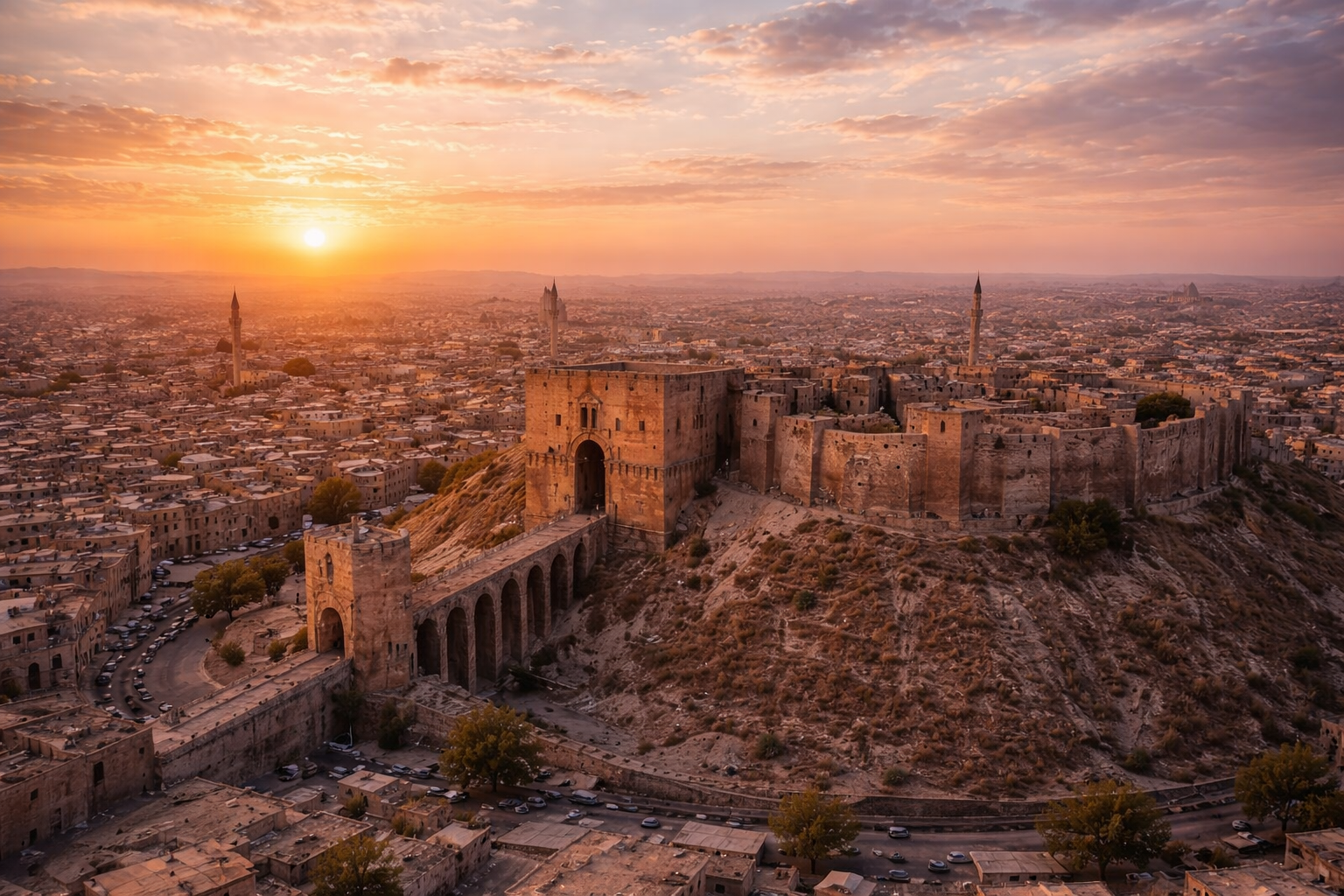
Aleppo Citadel is one of the oldest and largest castles in the world, located in the heart of Aleppo, Syria, with a history dating back thousands of years.
Aleppo Citadel, known locally as Qal‘at Halab (قلعة حلب), stands as one of the world’s oldest and most impressive fortifications. It rises as a sentinel of history above the ancient city of Aleppo in northern Syria.
With a recorded past stretching back more than 4,000 years, this iconic structure is far more than a castle. It is a living testament to the civilizations, empires, conflicts, and cultural richness that have shaped the Levant across millennia.
📍 Location and strategic importance of Aleppo Citadel
The Citadel rises dramatically on a natural limestone mound at the heart of Aleppo, Syria’s second-largest city. From this elevated position, it commands sweeping views over the surrounding urban landscape. This commanding height reflects the site’s long-standing strategic importance.
Because Aleppo lay at the crossroads of major trade routes connecting Mesopotamia, Anatolia, Egypt, and the Eastern Mediterranean, control of the city—and its fortress—was synonymous with political power for millennia.
🕰️ Aleppo Citadel: A Journey Through History
Ancient Foundations
The origins of the site go back to at least the middle of the 3rd millennium BCE, when the mound was used in religious or administrative contexts. Over time, the settlement grew in importance; its hilltop position was ideal for defense long before formal fortifications were built.
Classical & Medieval Periods
By the Hellenistic era, the mound had evolved into a fortified acropolis. However, most of the Citadel’s visible structures today date to the medieval Islamic period.
In particular, the Ayyubid and Mamluk dynasties between the 12th and 16th centuries shaped the Citadel’s current form. During the reign of Al-Zahir Ghazi, the son of the legendary Muslim leader Saladin, extensive construction and reorganization transformed the site into a sophisticated military stronghold.
This development included a monumental fortified gate, a deep defensive moat, and a labyrinthine entrance system. These winding passages were deliberately designed to slow attackers and expose them to defensive fire from above.
The Mongol and Later Periods
In 1260, the fortress suffered major destruction from Mongol forces, followed by further damage in 1400–1401 during Timur’s invasion. It was restored later in the 15th century by Mamluk rulers, who added new towers and a grand palace hall. Through the Ottoman era (1516–1918) and into modern times, the Citadel transitioned into administrative and symbolic roles even as its military importance waned.
🔱 Architectural features and interior design of the Aleppo Citadel
The Aleppo Citadel is remarkable for both its scale and architectural complexity. Within its walls, the fortress encloses a wide range of structures that once sustained daily life. These include mosques, palaces, granaries, military barracks, baths, and vast water cisterns.
Notable landmarks such as the Great Mosque inside the Citadel, the Ibrahim al-Khalil Mosque, and the defensive towers reflect successive phases of artistic expression and military innovation shaped by different ruling powers.
Equally impressive is the main gateway, which is reached via a massive stone bridge spanning a deep defensive moat. The entrance passage was deliberately designed with multiple sharp turns, a strategic feature intended to slow invading forces and expose them to defenders, thereby providing a decisive tactical advantage.
🎯 The historical importance of Aleppo Citadel
Military & Political Power
For centuries, dominant powers in the region — including the Ayyubids, Mamluks, and Ottomans — fortified the Citadel to control Aleppo, one of the Middle East’s key cities. Its walls witnessed battles, alliances, and shifts in control that mirror the turbulent history of the broader region.
Cultural & Urban Heart
Beyond military roles, the Citadel functioned as a social and administrative center, blending daily life with defense and governance. Archaeological discoveries — such as Byzantine sarcophagi, temples beneath the fortress, and Christian, Muslim, and earlier artifacts — reveal a tapestry of cultures layered over millennia.
UNESCO World Heritage Status
In 1986, the Citadel — as part of the Ancient City of Aleppo — was inscribed on the UNESCO World Heritage List. This designation recognizes its universal cultural value and its importance as a shared treasure of humanity.
⚔️ The impact of modern conflict on the Aleppo Citadel and reconstruction
The Syrian Civil War (beginning in 2011) brought heavy fighting to Aleppo and inflicted damage on its historic core. The Citadel itself was damaged by bombardment and nearby clashes. However, restoration and conservation efforts have progressed, and the site reopened to visitors in late 2025 after extensive work, symbolizing resilience and cultural revival.

🏙️ Visiting the Citadel Today
How to Reach It
- From within Aleppo: The Citadel is centrally located in the old city and easily reached on foot from nearby historic markets (souk al-madina) and landmarks.
- From Aleppo International Airport: About 30–40 minutes by taxi or private car.
- Inter-city travel: Long-distance buses, shared taxis, or private vehicles connect Aleppo to other major Syrian cities such as Damascus or Homs — though travel advisories should be reviewed before planning.
Local transport is often informal, and visitors should carry some cash (Syrian Pounds) since card payments are not always accepted near heritage sites.
🎟️ Entrance Fees for 2026
As part of Syria’s updated heritage pricing, effective January 1, 2026, major archaeological sites are categorized into tiers.
- First-grade sites: Ticketed at 100,000 SYP
- Second-grade sites: Ticketed at 50,000 SYP
According to tourist listings, the Aleppo Citadel falls under the second-grade category, which puts its estimated 2026 entrance fee around 50,000 Syrian Pounds (roughly equivalent to $5 USD at typical exchange rates).
Prices can vary slightly for locals versus international visitors, and guided tours may cost extra; always confirm locally before visiting.
Discover more details about the Aleppo Citadel on our YouTube channel.
💡 Practical Visitor Tips
- Best seasons: Spring and Autumn offer pleasant weather for exploring open archaeological sites.
- Clothing & footwear: Wear sturdy shoes; the interior includes uneven stone floors and ramps.
- Photography: A wide-angle lens is ideal to capture both intricate details and dramatic scale.
- Local context: Respect local customs and restoration work; some sections may be temporarily closed for safety.
What is Syria? History and Facts
🌟 Why the Aleppo Citadel Matters
The Aleppo Citadel is far more than a fortress. It is a narrative etched in limestone — revealing stories of empires, trade, spirituality, resilience, destruction, and rebirth. From ancient Seleucid and Roman times, through Islamic dynasties, to the Ottoman period and the present day, the Citadel embodies the complex human heritage of the Levant. Its towers and gateways do not just overlook Aleppo — they connect modern visitors with thousands of years of civilization.
Visiting the Citadel is an invitation to walk through history, to reflect on the past’s echoes in the present, and to witness the tenacity of culture in the face of adversity.
Aleppo: History, Culture and Facts About Syria’s Oldest Cities
Leave a Reply