
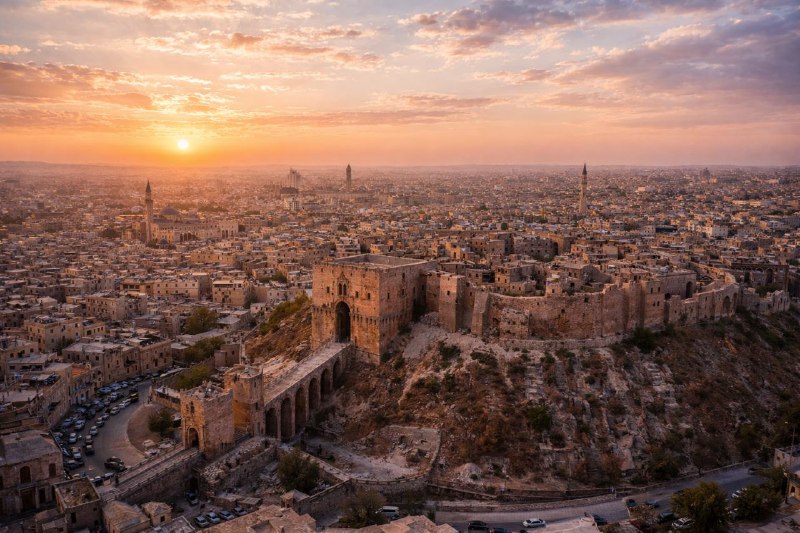
Aleppo is one of the oldest cities in Syria and the Middle East, famous for its history, culture, and ancient markets.
Aleppo, known for millennia in Arabic as Ḥalab, is far more than a city on the map. Indeed, it stands among the oldest continuously inhabited urban centers in the world. Here, ancient trade routes converged, empires collided, cultures blended, and history carved its marks into both stone and memory. ancient city in north west syria.
Across thousands of years, Aleppo evolved into a meeting point of civilizations, ideas, religions, and economies. In many ways, its story is majestic yet tragic and prosperous yet scarred. Thus, it serves as a powerful reflection of the broader history of the Middle East itself.
📍 Geography & Strategic Importance
Aleppo rises on a plateau in northwestern Syria, approximately 48 kilometers (30 miles) south of the Turkish border. Because of this, this strategic location positioned the city between Anatolia, the Syrian interior, and the Mediterranean basin. As a result, Aleppo naturally became a gateway linking Mesopotamia with the Mediterranean world.
In addition, Halab benefited from nearby fertile plains, access to vital water sources such as the Quwayq River, and its proximity to long-established caravan routes. However, geography alone did not merely bring prosperity — it shaped Aleppo’s destiny. In fact, control of the city meant control over trade corridors, military movements, and regional power dynamics. Therefore, this strategic value explains why Aleppo repeatedly became the object of conquest and competition throughout history.
🏛️ From Antiquity to the Medieval World: The Rise of a City
Aleppo’s documented history stretches back to the 3rd millennium BCE. Ancient texts from the city of Ebla referenced it as a significant urban center. Initially, early Halab grew around a temple dedicated to the storm god Hadad. Archaeologists later uncovered its remains beneath the medieval Citadel. This discovery became a powerful symbol of continuity between ancient belief systems and later civilizations.
Over the centuries, Aleppo passed through the hands of major regional and imperial powers.
First, the Akkadians, Hittites, and Assyrians integrated it into early Near Eastern empires.
Later, the Achaemenid Persians (6th–4th centuries BCE) governed it as part of a vast imperial network.
Subsequently, the Seleucid Greeks renamed the city Beroea and introduced Hellenistic urban culture.
After that, the Romans and Byzantines strengthened Aleppo’s role as a commercial and administrative center.
Finally, the Arab Muslims captured the city in 637 CE. They restored its Arabic name and integrated it into the Islamic world.
By the 10th century, Aleppo emerged as the capital of the Hamdanid dynasty. It was renowned for its cultural patronage. As a result, the city attracted poets, philosophers, and scholars. This transformed Aleppo into a center of Arabic literature and intellectual life.
During the Crusades, Aleppo became a key defensive stronghold. For example, leaders such as Nūr al-Dīn successfully protected the city. Later Ayyubid rulers, following Ṣalāḥ al-Dīn (Saladin), expanded its markets, fortified the Citadel, and founded educational institutions.
However, history brought devastation as well. The Mongol invasion of 1260 inflicted immense destruction. This was followed by periods of Mamluk rule. Later, nearly four centuries under Ottoman governance reshaped Aleppo’s architecture, trade systems, and social structure.
🛍️ Commerce, Culture, and Urban Life
Aleppo’s historical prominence rested heavily on its role as a commercial powerhouse. For centuries, the city functioned as a critical hub along the Silk Roads, thereby connecting East Asia, Central Asia, the Middle East, and Europe. As a result, merchants arrived from distant lands carrying silk, spices, cotton, metals, and luxury goods — and at the same time, they exchanged ideas alongside merchandise.
At the core of this commercial network, the Old City of Aleppo, designated a UNESCO World Heritage Site in 1986, formed the heart of this activity. It encompassed the imposing Citadel, monumental mosques such as the Great Mosque of Aleppo, traditional madrasahs, and vast networks of covered souks that stretched for kilometers. Moreover, these markets ranked among the largest covered bazaars in the world and served as the nucleus of daily life.
In addition, Aleppo’s urban fabric reflected its remarkable diversity. For generations, Arabs, Kurds, Armenians, Turkmen, Persians, Christians, Jews, and Muslims lived side by side, thus shaping a cosmopolitan society rooted in coexistence, craftsmanship, and commerce.
⚔️ Battles, Empires, and the Age of Conflict in Aleppo
Aleppo’s strategic importance repeatedly drew conflict. Throughout history, the city endured:
First, Byzantine sieges and Persian incursions.
Later, Crusader attacks during the medieval period.
In the 13th century, Mongol massacres devastated the city.
In the 15th century, destruction under Timur (Tamerlane) followed.
Subsequently, turmoil unfolded during World War I and the collapse of the Ottoman Empire.
However, no conflict marked the city as deeply as the Syrian Civil War, which erupted in 2011. Between 2012 and 2016, the City of history and peace became one of the war’s most brutal battlegrounds. During this period, intense urban fighting devastated neighborhoods, destroyed irreplaceable heritage sites, and displaced vast segments of the population.
Even after large-scale combat subsided, instability persisted. For instance, in November 2024, renewed clashes once again brought violence to parts of the city, thus underscoring the fragility of peace and recovery.

🕯️ Current challenges and resilience of the city of Aleppo
Today, the City of history and peace exists between ruin and renewal. Much of the Old City’s historic souks remains damaged, and only limited sections have been restored. Industries that once defined Aleppo, particularly textiles, have declined sharply. Meanwhile, economic recovery continues at a slow and uneven pace.
Despite these challenges, resilience defines the city’s present. Local residents, returning families, and international organizations actively participate in reconstruction. For example, institutions such as UNESCO, the Aga Khan Trust for Culture, and UN-Habitat support heritage restoration, artisan training, and urban rehabilitation projects.
A video about Aleppo is on our YouTube channel.
Through these efforts, Aleppians strive not only to rebuild structures, but also to preserve identity, memory, and continuity in the face of prolonged hardship. In doing so, they seek to maintain a living connection between past, present, and future.
Idlib Facts: Syria’s Olive City Explained
🧠 Aleppo’s Legacy: Past, Present, and Future
Aleppo’s narrative extends beyond destruction. Instead, it is a story of endurance, cultural synthesis, and reinvention.
From ancient caravan routes to medieval scholarship, and from Ottoman trade dominance to modern industrial growth, the city has repeatedly adapted to changing realities over time.
Today, its future remains uncertain, yet its past offers guidance.
If Aleppo succeeds in blending restoration with renewal, while honoring heritage and at the same time embracing recovery, it may once again reclaim its role as a living crossroads — not only of trade, but also of culture, resilience, and human perseverance.
Leave a Reply