
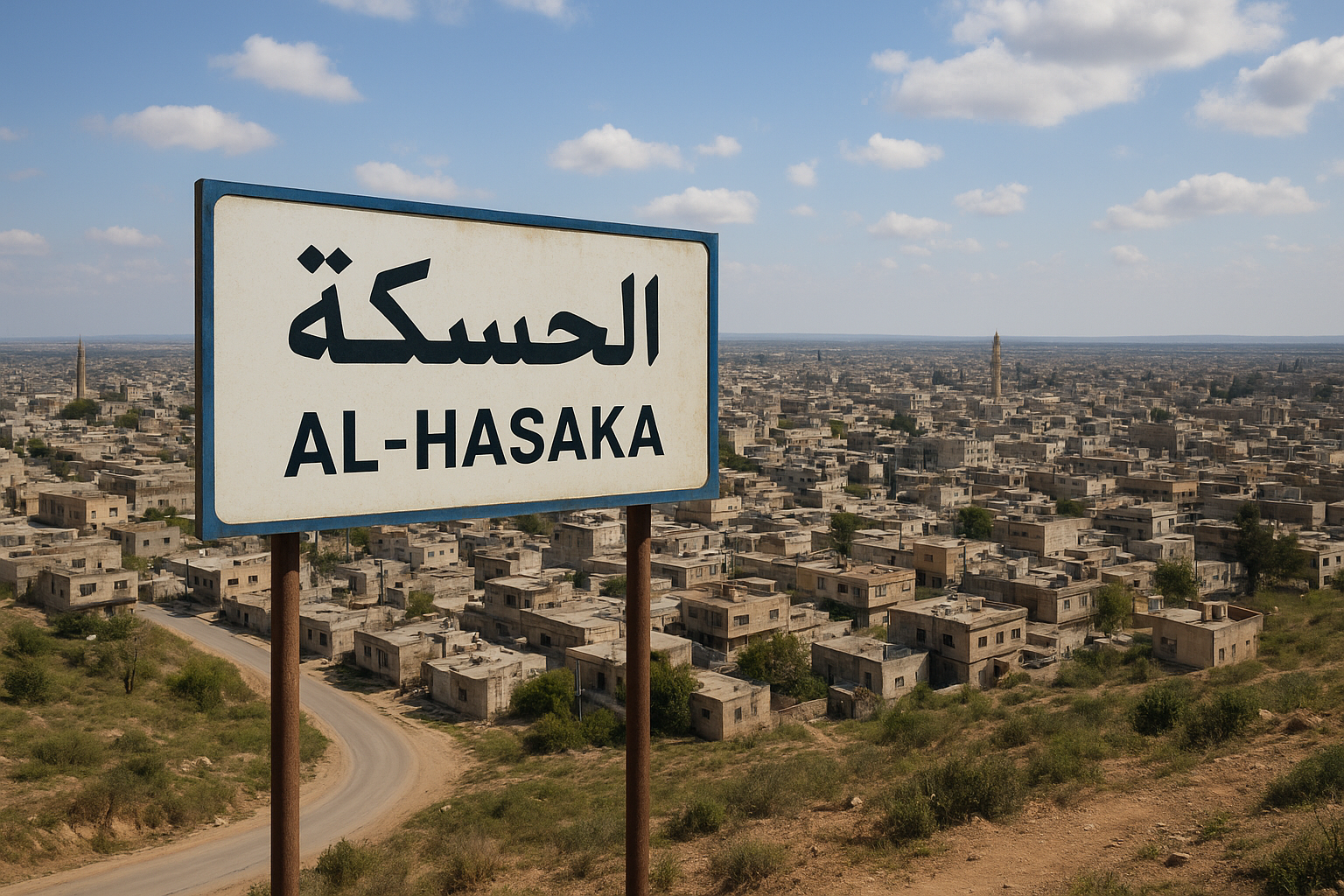
Al-Hasakah is a city in northeastern Syria, known for its agriculture, diverse population, and important role in the region.
Al-Hasakah Governorate, in the far northeast corner of the Syrian Arab Republic, stands as a land of ancient heritage, fertile plains, cultural diversity and enduring significance. Nestled between rivers, rich in archaeological treasures and shaped by centuries of human history, this region has been a pivot of civilizations and a witness to the triumphs and struggles of peoples throughout time.
The geographical location of Al-Hasakah: a land of rivers and fertile plains
Al-Hasakah occupies the northeastern frontier of Syria, bordered by Turkey to the north and Iraq to the east. Covering more than 23,000 square kilometers, it is one of Syria’s largest governorates by area. The region lies within the northern Jazira, a part of the Upper Mesopotamian plain — the fertile alluvial basin between the Tigris and Euphrates rivers that has nurtured human settlement for millennia.
Two rivers define the governorate’s landscape: the Khabur, a major tributary of the Euphrates, and the Jaghjagh, which flows into the Khabur near the provincial capital — the city of Al-Hasakah. These waterways have historically provided water for irrigation, enabling the area to be a breadbasket of grain and cotton and supporting sedentary agricultural life in contrast to the harsher Syrian Desert to the south.
The climate here features hot, dry summers and cool winters, with annual rainfall modest but sufficient — when combined with river irrigation — to sustain extensive agriculture.
Deep roots of Al-Hasakah: Ancient civilizations in Upper Mesopotamia
Long before modern administrative boundaries, the lands of Al-Hasakah played a central role in early human history. The fertile riverside plains of Upper Mesopotamia are among the cradles of civilization, where humans transitioned from nomadic hunter-gatherers to settled agricultural societies. This region fostered early urban centers and complex cultures thousands of years before classical antiquity.
Archaeological sites across the governorate attest to continuous habitation dating back to the Neolithic and Chalcolithic periods. Some of the most important prehistoric and ancient sites include:
- Tell Halaf — an ancient city mound whose excavations revealed successive settlement layers and finely crafted pottery and basalt sculptures, linking it to early Halaf culture of the 6th–5th millennium BCE.
- Tel Brak — one of the largest urban centers of third-millennium Mesopotamia, with monumental structures and evidence of craft specialization and trade.
- Tell Hazna — an archaeological settlement occupied during the Ubaid and Uruk periods with mud-brick architecture and artifacts reflecting early state formation
- Other sites — including Hamoukar, Tell Beydar, Tell Arbid and Tell Leilan, all showing layers of human occupation spanning thousands of years.
These tells — artificial mounds created by the accumulation of human habitation over time — underline the governorate’s prominence in the development of early civilization and long-distance cultural exchange between Sumer, Akkad, Assyria and neighboring regions.
A Tapestry of Empires and Peoples
Over the centuries, myriad civilizations and empires have held sway over Al-Hasakah. In antiquity, the area was part of the Assyrian Empire, its frontiers and trade routes linking vast territories from Mesopotamia to Anatolia. Later, it came under the influence of Aramean kingdoms, and subsequently the Neo-Assyrian, Babylonian, Persian and Hellenistic realms. With the rise of Rome and Byzantium, the region remained a strategic crossroads, absorbing influences from Mediterranean and Near Eastern cultures.
With the spread of Islam in the 7th century CE, Al-Hasakah integrated into successive Islamic caliphates and dynasties. During the Ottoman era (16th–early 20th century), it formed part of the Mosul vilayet, although the area remained relatively sparsely populated compared to other parts of the empire.
The 20th century brought seismic changes. Following World War I and the collapse of the Ottoman Empire, European colonial powers redrew borders. Under the French Mandate for Syria and Lebanon established after 1920, the modern settlement of the city of Al-Hasakah began to grow as a French military post and administrative center, attracting refugees from the Armenian and Assyrian genocides in the collapsing Ottoman Empire.

Strategic and Economic Importance
Al-Hasakah’s value stems not merely from its history but also from its agricultural and natural resources. The fertile Khabur basin has traditionally been among Syria’s most productive agricultural zones, yielding large quantities of wheat, barley and cotton. In fact, before periods of instability, the governorate contributed a substantial share of Syria’s grain output.
Beyond farming, the region sits atop significant oil fields. Exploration and production in the 20th century turned parts of northeastern Syria into energy-producing zones, feeding refineries and export terminals and contributing to the national economy.
Its location makes Al-Hasakah a strategic crossroads between Syria, Turkey and Iraq — a key transit corridor for commerce and interaction across the Fertile Crescent. This position has made it attractive not just for traders but for powers seeking influence over the region.
Video about the ancient city in the northeast on our YouTube channel
Recent developments and challenges in a Governorate
In the contemporary era — especially since the mid-20th century — Al-Hasakah has experienced both development and tension. Large-scale irrigation projects in the 1960s transformed swaths of desert into productive farmland, spurring urban growth and economic activity. Oil exploration in the 1970s further diversified the region’s economy.
However, social and political challenges have also marked its recent history. Policies aimed at altering the ethnic composition of the region — such as the “Arab Belt” project of the 1970s, which encouraged Arab settlement in traditionally Kurdish areas — contributed to demographic shifts and intercommunal friction.
The governorate’s diverse population — Arabs, Kurds, Assyrians, Armenians and others — reflects centuries of migration, settlement and cultural exchange. This pluralism is one of its defining characteristics, enriching its cultural life while also requiring careful navigation of competing identities and interests.
Daraa: History, Culture and Facts About Syria’s Southern City
Heritage and contemporary life in Al-Hasakah
Today, Al-Hasakah remains a place of contrasts: a region of ancient roots and ongoing transformation. Its archaeological sites offer windows into humanity’s distant past, while its cities and towns embody centuries of cultural interweaving. The fertile plains and rivers that once supported the earliest civilizations continue to sustain agricultural communities, even as modern challenges — environmental pressures, resource allocation and political complexities — shape everyday life.
From the tells of prehistoric settlements to bustling market towns and fields of grain, Al-Hasakah Governorate stands as a reminder of how geography, history and human resilience interact across ages. It is a land where the echoes of ancient empires mingle with the rhythms of contemporary life, offering a unique chapter in the broader story of Syria and the Fertile Crescent.
Leave a Reply